Category Archives: Around Town

Personal posts — some social justice (Not in Our Town), some faith-related (Princeton United Methodist Church), some I-can’t-keep-from-writing-this

War Stories at WIBA

“Coveting Not the Corner Office, but Time at Home,” a July 7 article in the New York times, resonated with me, as I am sure it did with thousands of women. It begins:

Sara Uttech has not spent much of her career so far worrying about “leaning in.” Instead, she has mostly been hanging on, trying to find ways to get her career to accommodate her family life, rather than the other way around.

I’d been pondering the balance between career and family as I prepared my speech for the WIBA “Women of Achievement” breakfast last month.

Along with three other women (Denise Taylor, Danielle Gletow, and Barbara Hillier) I was “honored to be honored” at this event. Richard K. Rein, my ex-boss at U.S. 1, wrote an “outsider” column about it, outsider because he was a man at a predominently female gathering. Rich comments that Hillier was the one who put the career balance thing in context. She used the familiar Ginger Rogers metaphor (does everything that Fred Astaire does, but backwards and in high heels) but it is oh so true.

In the ’60s, ’70s, and even ’80s, women did not have so many choices as we do now. But living with limited horizons can be easier. Each of us must find her own way.

Marion Reinson — whom I know from the chamber program committee and the former Einstein Alley Entrepreneur’s Group — wrote a sweetly complimentary account of the WIBA awards breakfast. I posted it on my personal blog for my grandchildren to read someday.

It’s more difficult than you’d think to be praised in public, but it was a truly wonderful event, planned to be specially nice from the table decorations to the engraved Simon Pearce glass bowl that the honorees received.

So here is the ultimate thank you to everyone on the committee, printing all the names: Elizabeth Hampton (chairperson), Brenda Ross-Dulan (emcee), Lorraine Holcombe (chamber liasion), plus Mary Betz, Dale Blair, Donna Bouchard, Jodi Brigman, Carol Einhorn, Michelle Everman, Robin Fogel, Danielle Gletow, Meg Helms, Judy Hutton, Heather Kumor, Nicole Lyons, Jane Mahon, Eileen Martinson, Susan Mullin, Helen Okajima, and Lucia Stegaru. You did a great job!

And while I’m at it, the sponsors were Wells Fargo, jasna Polana, WithumSmith+Brown, PNC, MacLean Agency, Fox rothschild, Lindt Chocolates, and Monday Morning Flower & Balloon Co. Thank you all again.

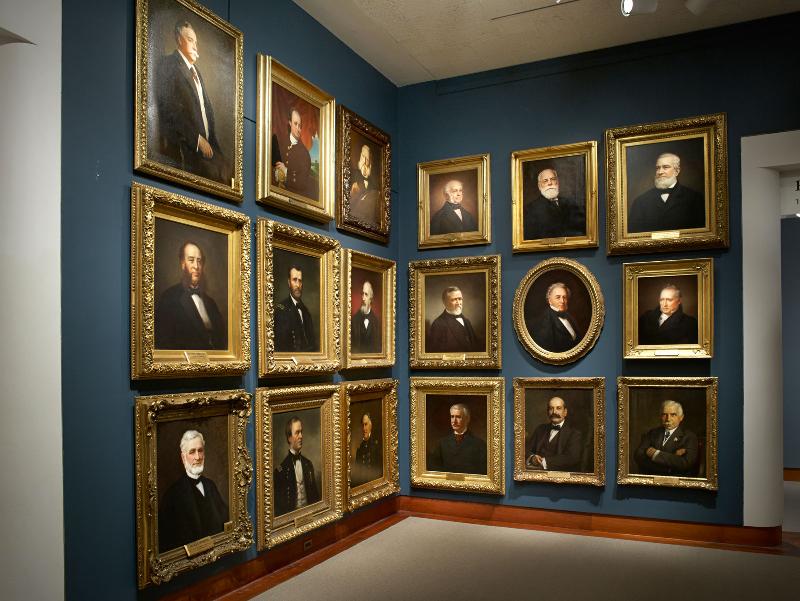
prince-2menFor just one day, at the Princeton University Art Museum, you can compare 19th century oil portraits of old, white (add two more adjectives, powerful and rich) men with 20th century portraits, photographs.

Shared Vision: The Sondra Gilman and Celso Gonzalez-Falla Collection of Photography has just opened and it highlights the enigmatic child pictured above.

Sunday, June 30, is the last day for Picturing Power: Capitalism, Democracy, and American Portraiture, brought to Princeton by courtesy of the Scheides (Judith and William). Your jaw will drop at the tier upon tier display of portraits of important men. These portrait painters knew their stuff — you can discern the personalities of the Carnegies, the Mellons, the Rockefellers, the Edisons.

The portraits used to hang at the chamber of commerce in New York until the display got so embarrassing (no diversity of sex or race) that the chamber sold it off.

When the portrait is on a wall, you can return the stare.


Shirley Satterfield’s Princeton

Shirley Satterfield guides tours of the Witherspoon-Jackson neighhborhood, the historic African-American district, on behalf of the Princeton Historical Society. Her most recent tour was on “Juneteenth,” the oldest nationally celebrated commemoration of the Emancipation, observed as a holiday in many states.
Satterfield, who grew up in Princeton, was both informative and interesting — a hard combo to achieve on a tour like this. The tour is named after Albert E. Hinds, who worked on the crew that paved Nassau Street. Satterfield offers her tours to public and private groups, and the self-guided pamphlet can be purchased for $1 at Bainbridge House.

This picture is taken from the steps of the house where Paul Robeson lived as a boy, and it is across the street from the gate to the “colored” section of Princeton cemetery. Paul Robeson’s father and mother are the only African Americans buried in the main section of the cemetery, designated for whites.

Yes, though it was north of the Mason Dixon line, Princeton was a Jim Crow town.

Ed Felten: Foil the Online Trackers

How to foil the “trackers,” those who follow you on the web in order to market to your tastes? If you are buying health products, and you don’t want the insurance companies to know about your condition, buy with cash and without a loyalty card, says Ed Felten, the computer science and public affairs professor at Princeton University who just finished a year in DC as chief technologist for the Federal Trade Commission.  Felten  was quoted in the New York Times on Thursday in “Ways to Make Your Online Tracks Harder to Follow”

If you don’t want to always pay with cash, preserve your online privacy with this Felten tip: use a different browser (Chrome, Safari, and Firefox) for each of three online activities: email, social networking, and general browsing.

The NYT reporter, Natasha Singer, had a clever “ender.” She quoted Hester Prynne in The Scarlet Letter:  “We must not always talk in the marketplace . . . of what happens in the forest.”


Hotel Mavens: Rabon and Kunz

Two women who know a thing or two about treating hotel guests well — Lori Rabon and Deborah Kunz — will have their say in the next couple of days. Rabon is being honored, deservedly so, for her unstinting dedication to the cause of Princeton’s tourism community. She chaired the CVB, the moniker for the Convention and Visitors Bureau, for the Princeton Regional Chamber of Commerce, for 10 years. She is also the general manager of the Nassau Inn in the heart of Palmer Square. Well done, Lori — and continued success with the hotel. A reception in her honor is on Thursday.
Kunz is the former customer service manager at the Hilton Hotels, and her topic is — yes, customer service. She speaks at the Princeton Regional Chamber breakfast on Wednesday, June 19, at 7:30 a.m. at the Nassau Club.
Some Princeton retailers do very well on customer service; I will leave the rest unsaid. But we can all pick up tips. About 10 years ago I remember interviewing a speaker who implored Princeton retailers to join together in marketing — not just their own enterprise — but the Princeton region as a whole. Do you have a tourist in your store? Offer sightseeing tips. A good “insider” tip is the photo opp by the Einstein statue, or the Einstein exhibit at Landau’s.
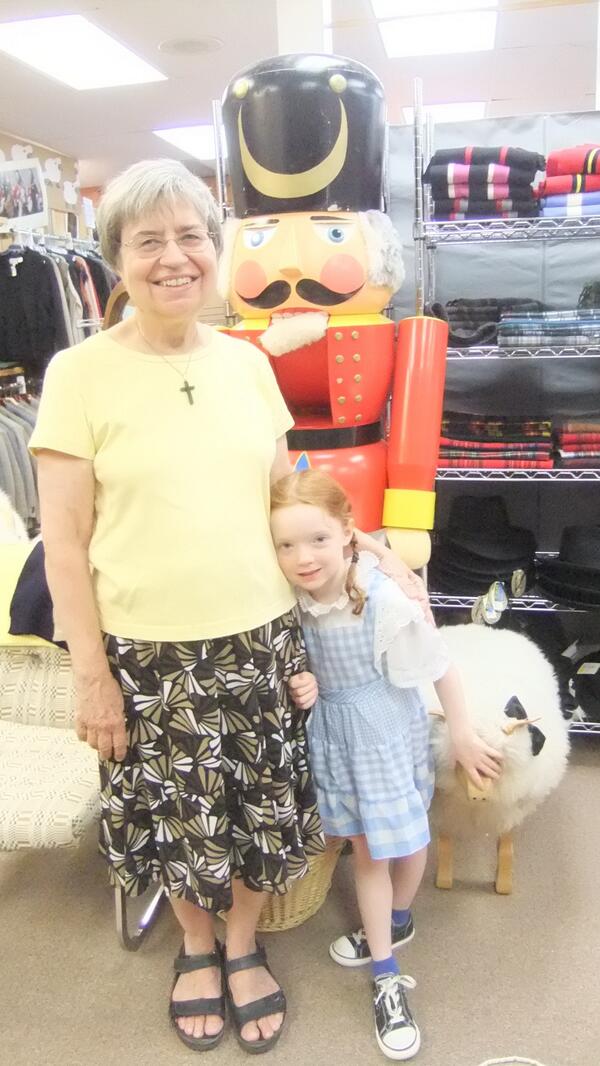
And did you ever offer to get behind the tourist’s camera? Someone at Landau’s did that, took my camera to get a photo of my granddaughter and me and earned a soft spot in my heart for at least 4 years. That’s customer service.
annie at landaus<a

Support ‘Ban the Box’ on June 13

ban box color

If a man serves time in prison, will he ever have the opportunity to compete for a job? Not likely, unless proposed legislation passes the State Senate. The  NJ Opportunity to Compete Act (S2586), otherwise known as Ban the Box, will be discussed Thursday, June 13.  It would let someone with a prior criminal record — who posed no threat to society — to apply for employment without having to disclose the record on the very first application. Time enough to reveal that in the interview. For more on how to support this legislation, click here. 


Karen House with Alice Barshaw

Karen House with Alice Barshaw

Karen House (right), former publisher of the Wall Street Journal, with Alice Barshaw, on the staff of the Princeton Regional Chamber. Karen spoke at the chamber on June 6.

Not Just Old White Men

Image

That someone in the Medici family had African heritage may come as a surprise, but that’s what we learn in Revealing Presence in Renaissance Europe, on view through Sunday at the Princeton University Art Museum. When Alessandro de Medici, the out-of-wedlock son of Pope Clement VII and an African maid in the Medici household., became the Duke of Florence, there were no full-face portraits of him. Contemporary portraits showed him with a hood. After his death the portrait was painted that hangs on banners all over campus to promote the exhibit. Look here for an intriguing art history puzzle, about the picture next to it. The label on the picture reveals the sad fact that Alessandro was no popular favorite, “tyrannical,” is the word they use.

It’s definitely worth trying to get there before this exhibit closes on June 9. And it makes an intriguing juxtaposition to the four walls of shoulder to shoulder portraits of Old White Powerful Men, the former portrait collection of the New York Chamber of Commerce.  J. Pierpont Morgan, William H. Vanderbilt,  Grover Cleveland — these portraits are fascinating because the  personality of each man shows through.

This exhibit has a different title from the one I used, but the bottom line is — that when the need for diversity came along, i.e. the idea  that women and people of other races might possibly be admitted to the great halls of business, the paintings needed to go. As the New York Times review says, “old white men did not fit in with the chamber’s commitment to diversity. ” They are now owned by Credit Suisse and on view in Princeton through June 30.

If you think that in 2013 nobody makes politically incorrect comments about race, or gender, think again. Today in the racing column of the New York Times, in a discussion of a filly that will run in the belmont, a veterinarian was quoted as saying, “It takes a special filly, one that is willing to stare down the boys and say, ‘No this one is mine.’  It’s so much about personalities and intimidation when these horses match up. I think it’s the same reason women don’t have as much, and the same kind of success, as men in the workplace.”

I would be more outraged, except that the person quoted was a woman.

Moshe Budmor’s retrospective

Moshe Budmor is one of my favorite people.  In the ’80s, I reviewed the multimedia works that he and his amazing wife, Katya Delakova, staged.  He is having a retrospective concert on June 15 and a writing buddy of mine, Michele Alperin, did this terrific profile.  by Michele Alperin. I like the one Michele wrote for the Packet, even better (am waiting for it to go online). A concert of his music is June 15, 7:30 p.m., Bristol Chapel, Westminster Choir College. The concert is free. Call SAndy Sussman at 609-921-7334 or ssussman@princeton.edu.

Meanwhile two wonderful bits of his ever-so-wise advice: When you go to an interview, he was advised, “it means they like what they see and you can only spoil it through talking. if you let them talk, they feel that they had a wonderful conversation.” Continue reading Moshe Budmor’s retrospective

Orange and Black – and White Privilege

library
Hall of Privilege: The Mathey College Common Room includes a fireplace dedicated to a Rockefeller, Laurence, Class of 1932

“Unpleasant social encounters resulting from white privileges and preferences became a boot camp for survival,” said an African American, Robert J. Rivers, who grew up in Princeton, In 1953 he was one of the first African Americans to graduate from Princeton University. Many would say that “unpleasant social encounters” never happen today, but I’ll bet most of those deniers are white.

Rivers credits the desegregation pioneers, including Frank Broderick, Class of ’43 and editor of the Princetonian, who attacked the social and emotional hypocrisy of fighting for “democracy” without admitting black students.

Andrew Hatcher, who grew up in Princeton, was refused admission, and later became President Kennedy’s associate press secretary.

Dean Carl Fields (after whom the Fields Center is named) who set up ‘home away from home’ families for black students.

Image
Photo by Roland Glover

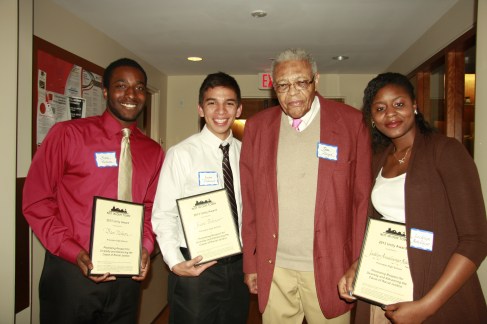
George Reeves, camp cook at Blairstown and grandfather of Jim Floyd, who graduated from Princeton in 1969. In the picture, he is shown with graduating PHS seniors Sam Nelson, Juan Polanco, and Jacklyn Adebayo, who received Unity Awards from Not in Our Town last month. (Floyd was so impressed by their accomplishments that he offered an additional gift toward their books at college.)

The speaker,  Rivers,  was one of three black students in a class of 700 in September, 1949. His account of the segregation and desegregation at this university, delivered at the Pan African Graduation in 2008, is an eye-opener. (This year’s event is Sunday, June 2 and I learned about this speech from a Facebook post from the Center for African American Studies.)

He concluded his speech in 2008 with appreciative words: But 55 years later, I count my blessings because I have been richly rewarded by unpredictable opportunities – and Princeton has changed.

Yet 55 years later, remnants of past attitudes emerge, as documented in Looking Back: Reflections of Black Princeton Alumni. Whites still have privileges that minorities do not.

On Commencement Eve, Not in Our Town will host Continuing Conversations on Race at Princeton Public Library. That’s Monday, June 4, at 7:30 p.m. In a discussion entitled Tongue Tied? Rehearse What to Say, we will talk about how to have a meaningful dialogue with people who have differing views about race and white privilege. You are invited.