 See/hear Wim Sweldens, co-founder and CEO of Kiswe Mobile, which offers multiple-camera streaming of sporting events for those watching games on their mobile devices. The talk, sponsored by the Keller Center, is on Thursday, November 6, at 4:45 in Princeton University’s Carl A. Fields Center on the corner of Olden and Prospect. Sweldens is the Belgian computer scientist who founded the Bell Labs skunkworks, Alcatel-Lucent Ventures. He is now Entrepreneur of the Year at Columbia. It’s free. Topic: “Entrepreneurship and the Interplay with TV, Mobile, and Social.”
Category Archives: Technology & Innovation
“Distracted from distraction by distraction”
That line of T.S. Eliot was a favorite of mine in my more desperate times as a college senior. So when I am feeling desperate more than 50 years later, I know it did not come as a consequence of old age. The distractions are different, but my readiness to put up with them is probably in my DNA.
 I am putting November 6 at 2:30 p.m. on my calendar, to hear an expert on calming technical distractions (Alex Pang) speak to a Princeton University Atelier lass on “Contemplative Computing: Reclaiming Attention in the Age of Distraction.
Pang wrote The Distraction Addiction, with one of the subtitles “Taming the Monkey Mind.”
I just wonder if, after so many years, my distractable simian mind even wants to be tamed.
Surveillance Knights: Doctorow and Felten

Liberation can turn into surveillance, they warned. Two anti-surveillance knights of the internet, science fiction author Cory Doctorow and Princeton University tech guru Ed Felten, spoke at Labyrinth Bookstore today, co-sponsored by the Princeton Public Library.
The Internet is the nervous system of the 21st century, said Felten. Just as language helped cave men collaborate, the Internet helps us organize at lower costs. It transcends what a single person can do. It is a mistake to try to control the Internet and fit it into something small, said Felten. “It was architected to let people try things and discover what worked.” If over controlled and regulated, we will lose that freedom.
YouTube needs to be free from regulation. Every minute, 96 hours of video are uploaded onto YouTube, most of it personal, says Doctorow, and that’s OK. Each of the seemingly banal interactions — like the ubiquitous cute cat videos — is important. “Relationships are built up on these little moments,” said Doctorow.
What these like-minded experts said can be found in their writings, but Felten used a homey example to explain his objection. When the Keurig coffee maker patent expired, you could buy private label pods. Then Keurig engineered its new coffee makers so only its own pods worked. “That’s like patenting shoelaces, so you need European rights to tie your shoelaces in Germany.”
Doctorow cited software that can deactivate engines if the car is stolen. It might be sold to vendors of subprime car loans. Wireless pacemakers can be hijacked. For instance, one demo showed a pacemaker hooked up to a strip of bacon — and it fried the bacon.
As efficient and valuable as the Internet is, the Doctorow/Felten meeting demonstrates that nothing beats personal networking. PPL’s Janie Hermann (between Doctorow, on the left, and Felten) encountered Doctorow at a library convention over two years ago and learned that he was a buddy of Felten’s. Since that meeting several attempts were made to bring the two together for a conversation in Princeton, but schedules never matched. Three weeks ago Hermann learned that not only did Doctorow have a new book coming out but that he would be in the area for New York City Comic Con. She zoomed in on the rare opportunity and with very little notice was able to connect Doctorow and Felten at last, but the library’s community room was not available. Dorothea von Moltke from Labyrinth Books stepped in to offer her space for what turned out to be a standing room only event.
The Pinking of Princeton: Salary Gap?
Maria Klawe was named dean of engineering at Princeton University — soon after Princeton had its first female president. Unafraid to be ‘different‘ (she doodled and knitted at faculty meetings), she left after three years to be president at Harvey Mudd and to raise a feminist ruckus when appropriate.
Now, as reported in the New York Times today, she contends that because she (typical woman?) did not negotiate her salary, she was paid $50k less than she should have been. Wow.
The article “Microsoft Chief Sets of a Furor on Women’s Pay” is on the controversial statement by Satya Nadella that women “who do not ask for more money … would be rewarded in the long run when their god work was recognized.” His mea culpa refers to some other HR axioms that you may or may not agree with.
Meanwhile, if you want to see what this woman looks like, just go to the Friend Center, to the big room with the portraits of the deans, painted in oils by distinguished artists. All except one. Klawe’s is a watercolor, and it is a self portrait. Below.

Giving Away $5 Million Per Year
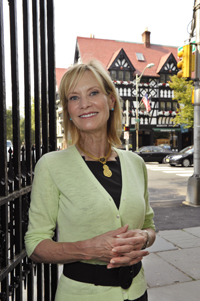
Money is always fun to talk about, to hear about. Big money is even more fun to hear about — especially when it is dispensed locally and you know a nonprofit that is getting some.
And I’m always fascinated by the person giving away the money. In this case, speaking at the Princeton Regional Chamber breakfast on Wednesday, September 17, it’s Elizabeth Christopherson, CEO of the Rita Allen Foundation and former head of New Jersey Network.
I interviewed Christopherson two years ago for U.S. 1, asking her what it was like to go from a nonprofit that needed foundation money, to leading the foundation that actually gave the money. She had just moved into her office on Nassau Street, over Hamilton Jewelers. At that time she revealed that “— despite her genteel women’s club demeanor, she is going hell-bent-for-leather on effecting transformative change.” (My words, not hers.)
She heads one of the larger foundations in New Jersey. The monies for it came from Rita Allen’s first husband, Charles Allen, known as ‘the Shy Midas of Wall Street,’ founder of Allen & Company, the prominent boutique firm that is famously averse to publicity. That’s a story in itself.
Now the $140 million foundation grants more than $5 million per year. Previous grantees have been Isles Inc. and Stony Brook Millstone Watershed Association.
Looking at the current web page for the foundation, it seems to me that Christopherson has realigned its focus. And she has planted it firmly in the 21st century. For instance, the website offers a social media guide for nonprofits, a downloadable PDF.
I’m eager to hear how Christopherson has settled into the job. Two years ago she admitted that what sounds easy — giving away money — is not easy. “There are not enough funds, and we try to be as strategic as we can be,” she said. “It is very difficult to say no when you care — and we do care.”
‘What have you done for the world today?’
They had a party for Len Newton on Friday. There was a prayer. There was a military presentation of the American flag to Ruby, his widow. There were pictures, and speeches, and food, and memories of Len, who died at the age of 88 on July 19.
Most of all there was respect. Jim Floyd told of how Len helped to create Princeton’s first integrated neighborhood. Len marched in Washington for the “I Have a Dream” speech and again for its 50th anniversary.
Len was a stickler for accuracy and challenged lazy assumptions. In the ’80s and ’90s when U.S. 1 Newspaper staged forums, Len was first at the mike, asking the most challenging question. To an article about Opinion Research (the founder of Response Analysis, Len had pioneered at Opinion Research) he wrote an exquisitely measured letter, partly in praise, partly in correction.
Old age didn’t stop him from his passion for identifying a problem and trying mightily to correct it. When the recession hit, he enlisted the resources of the MIT Club (he had been the president) to create jobs in New Jersey. He talked and urged and bent ears to get people to join him in this effort. He enlisted competent people who helped stage an innovative job fair.
Len’s decline was swift — two months. As late as last year, he wrote urging me to note the passing of a pillar of his church, Witherspoon Presbyterian, the first church in Princeton to have significant racial diversity. As late as February of this year, Len was writing notes to Rich Rein at U.S. 1 Newspaper
An example of how he was amazingly active, even to the end: He astounded me and everyone else by showing up for a breakfast at Jasna Polana, where I was one of the keynote speakers. He didn’t tell me he was coming. He just hopped on a bus and got out at the corner of the vast golf course. Never mind that the entrance was a mile down another road. Somehow he made his way through the back entrance of the estate and found his way to the clubhouse for the gala occasion. In the pouring rain.
When Len Newton wanted to accomplish something, he didn’t take negative answers. His granddaughter summed his philosophy in a poignant speech at the wake, saying — whenever she saw him, he would always ask, “What have you done for the world today?”
What will Flint Lane do next?
Flint Lane is one of those guys who “looks over the mountain.” He invented an electronic bill presenting service that helped to found Paytrust, and changed the habits of the bill paying population. It sold, and then he then he started Billtrust. He kept popping up in articles at U.S. 1. most recently with moving 110 employees to American Metro Center. Now he owns (however did he get here?) a ping pong facility.
He got there by loving ping pong. Ping pong champion David Zhuang, as quoted in an engaging story by Nicole Mulvaney in the Times of Trenton, had been longing for a Central Jersey based backer to build a facility here. “Give me a guy who loves ping pong!” said Zhuang.
I got the “over the mountain” analogy from Universal Display’s Julie Brown. When she spoke at the Princeton Chamber last week, she said that was one of the secret’s of entrepreneurial success.
It certainly applies to Lane. And now Princeton has a new amenity.
If you perused the Darwin-and-the-finches story in the New York Times science section, you may not have noticed the story’s stars, Rosemary and Peter Grant, are from Princeton.
Their new and much-lauded book, “40 Years of Evolution: Darwin’s Finches on Daphne Major Island,” is just published by Princeton University Press. It tells of an evolutionary process that is taking place, not from century to century, but from generation to generation.
Jonathan Weiner, a Pulitzer Prize winner and fellow researcher, wrote the NYT story published yesterday. All I could think about when reading about the Grants’ travails on this lonely island is — I’m glad it’s not me that had to crawl on the rocks and live in a cave. Especially when I realize that I am about the same age.
A Big OOPS. I got the date wrong on the demo for the Keller Lab, as below. I said it was Wednesday in Princeton, but it was Monday. I missed it too. The New York version starts today (Tuesday, August 12) at 5 p.m., details here.
It is fun to read about the different companies and their technologies.
Original post below, edited to take out the wrong date.
Universal Display was the brain child of a Princeton University faculty member (see story on Julie Brown). This summer the Keller Lab at the university is also hatching tech startups from students at what is known as the ‘e-Lab.” U.S. 1 has a story about one of the startups, Solstice Intitiative. Another is Space Touch (video demo here). Here was the program.
How They Did It: Julie Brown

It’s always exciting to hear from folks who were on the ground floor of a successful company. Julie Brown, the speaker for Thursday’s Princeton chamber lunch, was on the ground floor (well, actually, the second floor over Hoagie Haven) of Universal Display Corporation, now with global partners and 125 full time workers in Ewing. Your cell phone probably has UDC’s display technology.
Click here for lunch information. I’m looking forward to this — Julie was one of the most interesting people I’ve interviewed.
 Princeton Comment