Category Archives: Technology & Innovation

For all my techie friends — in the Einstein Alley groups, NJEN, the Keller Center, and the E-Quad — event notices, items from U.S. 1 Newspaper and the NYT

The Pluses of Google Plus: @LynetteRadio

lynette
Lynette Young screens her home page, Purple Stripe Productions.

 Just after graduating from high school, Lynette Young ran a project with 40 network engineers, all many years her senior. “I’m a geek by heart, a marketer by necessity,” admitted Young. She demonstrated both at the September 19 joint meeting of the IEEE and NJ CAMA when she taught about about Google Plus. After 2 1/2 years, she said, it is tipping into the mainstream, is bigger than Twitter, and is the second business social networking site.

Facebook is good to connect with people you already know, but  Google Plus takes you to the rest, she said. Then she gave chapter and verse on how to do it. Own your page,” admonished Young. If you are a bricks and mortar business, capitalize on Google’s attention to “local.” For instance, if  you have a restaurant  be aware that Google now owns Zagat, so your reviews are live on Google Plus

The “hangout” and the “HOA” are new and exciting tools. You gather up to 10 friends or clients, tape your conversation live (hangout) then post it on YouTube (hangouts on air). That’s convenient because Google owns YouTube. It sounds like a marketing bonanza.

If you have a restaurant, Google now owns Zagat, so your reviews are live on Google Plus. “Own your page,” admonished Young. Bricks and mortar businesses should capitalize on Google’s attention to “local.”

I must admit I am still slightly paranoid about Google knowing everything about me. Somehow I had a “slip and fall,” and I fell onto the Google Plus platform. Now I’m in a lot of “circles” though I don’t have any “circles” of my own.  I’ll look into this. If you get notified that you are in one of my circles, you might start receiving Princeton Comment in a different way. (As always, you may unsubscribe and I won’t hold it against you 🙂

A second chance to hear Young is at the PC Users Group at the Lawrence Library on Tuesday, September 24, at 7 p.m.  She will tell more about how to put together hangouts and HOAs. “Set up the webcam, invite nine people, record it, port it, done.”

But the real problem with talking heads  is — are they interesting? Present company excluded,  I think talkers are more likely to be boring than writers.

Wishing It Were August Again?

October-2nd-Save-the-Date-Website-644x1024

Wednesday morning I’m looking forward to hearing from James Steward, the Gee-Whiz-How-Does-He-Do-It director of the Princeton University Art Museum. In his short tenure he has partnered with all kinds of organizations to bring new audiences to one of the best kept secrets on campus. He’s at the Princeton Chamber breakfast ($25 for members at the door).

Thursday I’m going to learn how to wrestle with Google Plus, when NJ CAMA (stands for advertising and marketing etc.) hosts Lynette Young on the university campus. If you have added me to your Google Plus circle, I have not added you. I don’t embrace what I can’t understand.

Friday it’s off to Rider University to see the opening concert of American Repertory Ballet and its gorgeous young dancers (it repeats Saturday). Also on Friday, Philadanco comes to TCNJ. And the next day, Saturday, September 21, dancers dance for world peace at the Princeton YWCA.

What drives all this activity? Volunteers, of course. Volunteers in general, and some specifically, will be honored in a gala, staged by Volunteer Connect, on Wednesday, October 2, at Grounds for Sculpture, as you see at the top of the post. Volunteer Connect helps non-profits get skilled help, and helps professionals develop their skills.

Somewhere in between I’m talking to Folks That Know about technical innovations in Mercer County. I’m writing a preview for the October 4 “Mercer Makes” seminar. That’s only three Fridays away — perhaps pencil it in.

Septembers are always busy, but does this one seem more so?

jon peter

Being early is not too different from being wrong, said Jon Gertner, speaking to the Princeton Regional Chamber at the August breakfast. The author of The Idea Factory: Bell Labs and the Great Age of American Innovation (Penguin Press, March 2012) gave glimpses of the clashes and collaboration that led to innovation at Bell Labs, the consolidated R&D center built at Murray Hill when AT&T was the largest company in the world in terms of revenue, assets, and employees.  A former New York Times Magazine  writer (2004-2011) Gertner is currently editor-at-large at Fast Company magazine

He illustrated the danger of being “early” with the enthralling story of vacuum tubes and transistors.  When the 101-D vacuum (or repeater) tubes (which enabled sound to be relayed from switch to switch across the country) was being hailed as “the great miracle device of our time,” Bell Labs CEO Kelly considered it an inherently flawed technology.  He was determined to find a technology based on silicone and germanium not susceptible to weardown and breakdown.

His mindset drove the “solid state” team to get rid of the relay switches and find an electronic solution: the first transistor in November, 1947. What happened next was that the transistor was basically abandoned by Bell:  It was costly to produce.  Only the US Military kept it alive until continued innovation led to lower cost.  At the same time, the press hailed solar, created to get electricity to remote areas.  Yet the fad for solar soon faded since there was no comparable drop in cost. 

The “Being early” mantra was just one of the takeaways. Others: 

  • First identify large, significant problems and then attack them to achieve breakthroughs
  • Innovations by definition have both scale and impact on society
  • There is no set way of making breakthroughs
  • Failure is an inherent part of innovation.
  • We don’t foresee the use and value of breakthroughs.
  • When inventions are not effectively commercialized, the inventors will scatter and create their own companies but the company that spawned them may die.

As several members of the Chamber observed, substantial governmental subsidies at every stage, combined with the backdrop of 23 operating companies providing capital, made it possible for Bell Labs to fund basically anything.  Bell Labs had the freedom to concentrate not on quarterly profits and consumer goods but rather to focus on the foundations of our live.  They changed our world and our lives.

Guest Post: Karen L. Johnson

mehta johnsonThanks to Karen L. Johnson for this account of an important evening at the Princeton Tech Meetup. One must be a member to be told the location — but the Princeton Public Library is one of the sponsors! And the next meetup is Tuesday, August 27. BFF’

When Princeton techies gathered Tuesday night at Meetup Princeton Tech, they were treated to an energy-charged talk by Nihal Mehta. He captivated Creatives, Entrepreneurs, Investors, Service Providers and Techies (whose color-coded badges made for easy networking) with his roller-coaster ride in mobile tech marketing – 5 startups in the last dozen years.

Among his ventures is ipsh!, one of the first full-service mobile marketing agencies which he founded in 2001
and sold to Omnicom in 2005 (NYSE: OMC), buzzd, a real-time city guide which evolved into LocalResponse, which gives marketers real-time consumer input. Active angel investments to his credit include Admob (sold to Google), Greystripe (sold to Valueclick), and Movoxx (sold to Adenyo).

Mehta took what in a sense was a victory tour in Princeton. That he resigned himself by going to UPenn when Princeton wait-listed him was lost on no one, nor were his exhortations to all to leave the 40-hour/week job for the exhilaration and despair of the 100-hour week of the
entrepreneur, that being a self-established metric for his speech’s success.

Interspersed in his stories of failure and success as a mobile tech entrepreneur were quotations from Jay-Z, Nelson Mandela and tales compete with accents of his Indian family gatherings where his aunties tisk-tisked about the boy-who-went-bankrupt and later counted their cash as his ventures proved successful. Mehta advised people to “Take the wrong path the fastest…” so they could get through the steep learning curve from failure to success. With his record and the inspirational words, the 225 attendees stayed on a high-energy level.

After Mehta’s talk, new apps were presented by their creators, then the mic was offered as many persons as could be crammed into the remaining 2-minute segments. Those with new endeavors solicited feedback and collaborators as they headed off in many directions, as Mehta did before them.

Photo of Mehta and Johnson by Marek Malkowski.

Glenn Paul: From dotPhoto to the Digital Divide

Every time I wrote or edited a U.S. 1 story about Glenn Paul, we said he was a serial entrepreneur. In the latest U.S. 1 cover story on Paul, by Michele Alperin, he insists that he’s just a computer guy who has had to change with the technology. He has a good cause, and she’s written a good story.

Ed Felten: Foil the Online Trackers

How to foil the “trackers,” those who follow you on the web in order to market to your tastes? If you are buying health products, and you don’t want the insurance companies to know about your condition, buy with cash and without a loyalty card, says Ed Felten, the computer science and public affairs professor at Princeton University who just finished a year in DC as chief technologist for the Federal Trade Commission.  Felten  was quoted in the New York Times on Thursday in “Ways to Make Your Online Tracks Harder to Follow”

If you don’t want to always pay with cash, preserve your online privacy with this Felten tip: use a different browser (Chrome, Safari, and Firefox) for each of three online activities: email, social networking, and general browsing.

The NYT reporter, Natasha Singer, had a clever “ender.” She quoted Hester Prynne in The Scarlet Letter:  “We must not always talk in the marketplace . . . of what happens in the forest.”


Chris Kuenne: Secrets of His Success

kuenne talks

A year after he sold his company, Rosetta, for more than $500 million dollars, 13 years after he founded the firm, Chris Kuenne began grooming his successor, and at the 15 year mark he is now, basically, “emeritus.”

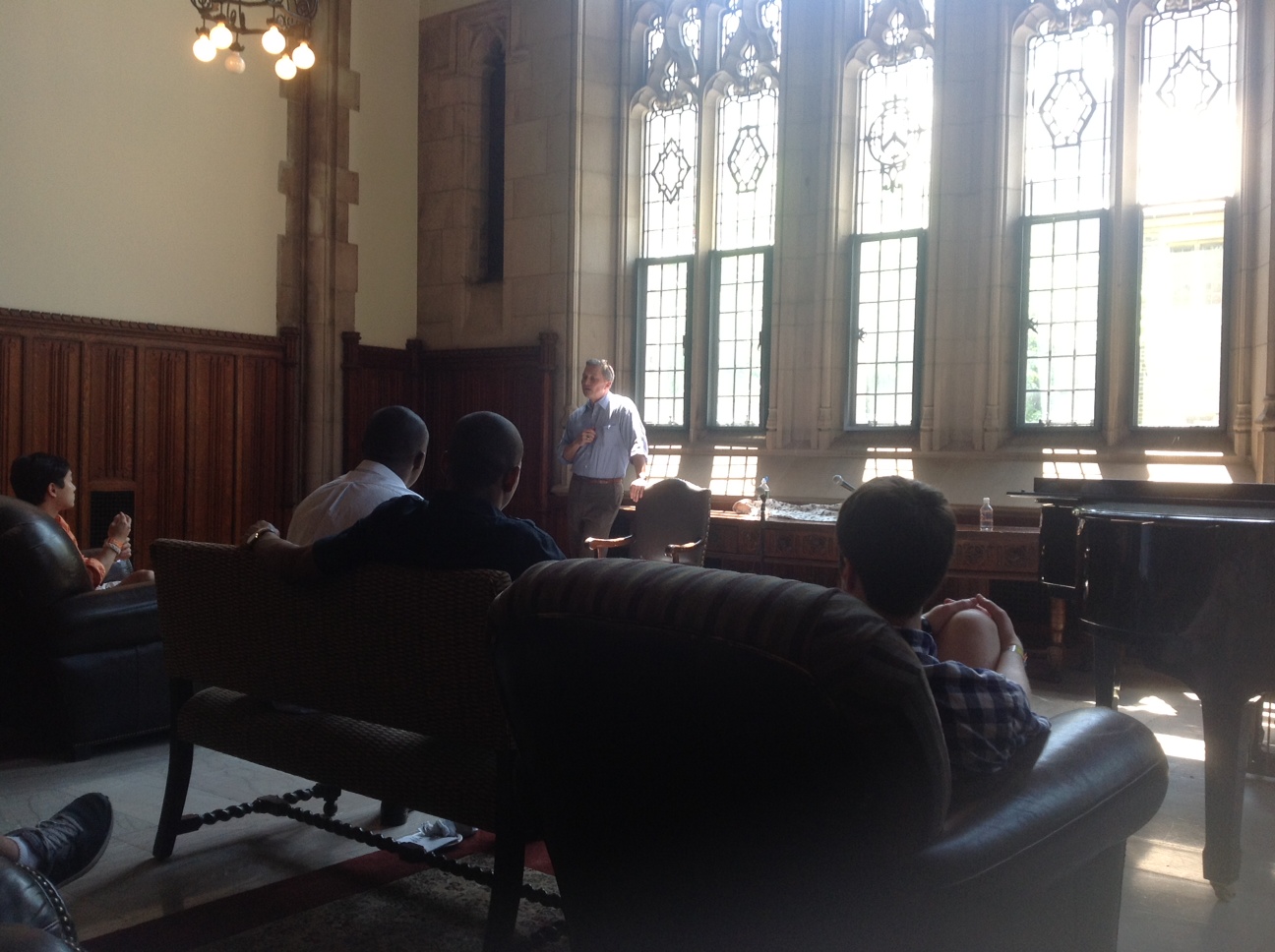
He’ll begin teaching High Tech Entrepreneurship in the fall, and he spoke to an SRO group, without notes, as part of the reunion activities for the Princeton Entrepreneurs Group. Continue reading Chris Kuenne: Secrets of His Success

Orange and Black Entrepreneur: Chris Kuenne

Chris Kuenne
Chris Kuenne

Chris Kuenne was one of my favorite interviews in 2010.  He founded Rosetta 15 years ago and sold it to Publicis for $575 million three years ago. He will speak at the Princeton Entrepreneurship Club reunion event on  Friday, May 31, 11 to 12:30 p.m. at the Mathey College Common Room.

Kuenne graduated from Princeton in 1985 and will follow  Ed Zschau, in teaching the university’s very popular (highly competitive)High Tech Entrepreneurship class.

Read about the university’s success in commercializing technology in the cover story of this week’s U.S. 1  Newspaper. 

Both Ends Burning: Entrepreneurial and Parental Dedication

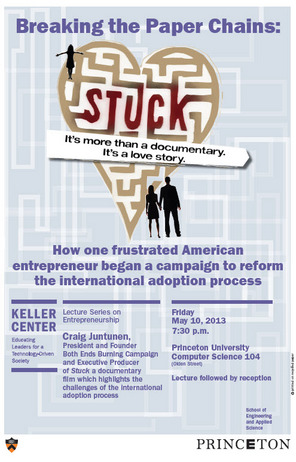
Entrepreneur Craig Juntunen adopted his three children from Haiti seven years ago, and realized how dysfunctional the adoption process was. He formed Both Ends Burning, a nonprofit dedicated to reforming the system, and produced a documentary, “STUCK,” designed to educate the American public about the 10 million children around the globe victimized through disinterest and unnecessary bureaucracy. 


Juntunen will speak about his cause tonight, Friday, May 10, in the computer science building, Room 104. A reception follows. He will premiere the film on Saturday, May 11, at the Montgomery Cinema, at 7 p.m. For tickets, click here. Juntunen is wrapping up a national tour for the film, and his appearance at the university is sponsored by the Keller Center. 

He Helped Make the Bomb

On Wednesday morning I heard Robbert Dijkgraaf speak about how the great minds of the Institute for Advanced Study did their research. That very afternoon, for the chamber’s Albert Einstein lecture, Nobel Prize winner Roy Glauber — who had been a visiting physics scholar at the Institute — told of the professional camaraderie of such great figures as J. Robert Oppenheimer and Edward Witten. Glauber was just 19 when the federal government sent him out to Los Alamos, where Oppenheimer was supervising the making of the atom bomb. (He hastened to say that the scientists had no say in how it was used.)

I took notes but don’t have time to write them. Fortunately, the Packet’s Philip Sean Curran did the job, as here. 

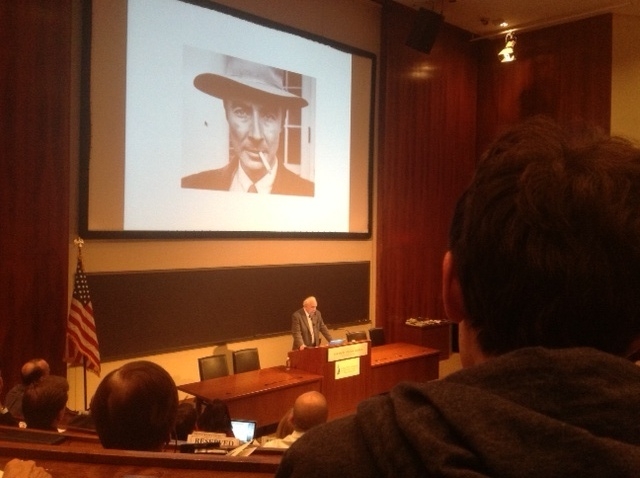
Glauber was engaging and entertaining as he spun his tales. And here are a couple of his pix.

In the first, Glauber wryly comments that it’s a privilege to know someone whose face is on a postage stamp. Of the Los Alamos crowd, John von Neumann and Richard Feyman gained the approval of USPS.

But Glauber says it was Robert Oppenheimer (next photo, looking dapper in an always-worn fedora and cigarette) who was really the point person on the project. Glauber believes that — without Oppenheimer — nobody else would have stayed. But his reputation was tarnished by Edward Teller, who wanted to pursue a different course of research. I suppose von Neumann was the one who emerged with his image intact. I’m going to put the book Glauber recommended, The American Prometheus; the Triumph and Tragedy of J.Robert Oppenheimer on my next-to-read list.

After the lecture I combed through the Institute for Advanced Study brochures showing scholars’ faces, names, and research topics, marveling at the diversity of topics, a bit saddened at the lack of diversity among senior faculty, but heartened by the rich diversity among the younger scholars. Who will be the next von Neumann?