The National Public Radio Morning Edition story on how the Amazon founder bought the Washington Post, fails to mention that Jeff Bezos is a Princeton alumnus, Class of 1986. He delivered the Class Day address in 2010.
Might it seem like a lucky coincidence that the New York Times just happened to print a big piece on the Post editor, Katharine Weymouth, on the day before? The reporter defended it, saying that she had been assigned the story a while ago but “didn’t get around to it” till July. I believe her. (Memo to self and other reporters: Don’t Drag Your Feet on the Good Story.) But it certainly was nice for Weymouth to get her spot in the sun before the storm broke.
And in the Snarky Section, that article drew darts for announcing what Weymouth wore to get her photo taken, and that she was able to wear a sleeveless dress thanks to her workout schedule. I say, Good for her! And I would want to know those details.
Photo of Katharine Weymouth by Matt Roth for NYTimes
How to foil the “trackers,” those who follow you on the web in order to market to your tastes? If you are buying health products, and you don’t want the insurance companies to know about your condition, buy with cash and without a loyalty card, says Ed Felten, the computer science and public affairs professor at Princeton University who just finished a year in DC as chief technologist for the Federal Trade Commission. Felten was quoted in the New York Times on Thursday in “Ways to Make Your Online Tracks Harder to Follow”
If you don’t want to always pay with cash, preserve your online privacy with this Felten tip: use a different browser (Chrome, Safari, and Firefox) for each of three online activities: email, social networking, and general browsing.
The NYT reporter, Natasha Singer, had a clever “ender.” She quoted Hester Prynne in The Scarlet Letter: “We must not always talk in the marketplace . . . of what happens in the forest.”
That someone in the Medici family had African heritage may come as a surprise, but that’s what we learn in Revealing Presence in Renaissance Europe,on view through Sunday at the Princeton University Art Museum. When Alessandro de Medici, the out-of-wedlock son of Pope Clement VII and an African maid in the Medici household., became the Duke of Florence, there were no full-face portraits of him. Contemporary portraits showed him with a hood. After his death the portrait was painted that hangs on banners all over campus to promote the exhibit. Look here for an intriguing art history puzzle, about the picture next to it. The label on the picture reveals the sad fact that Alessandro was no popular favorite, “tyrannical,” is the word they use.
It’s definitely worth trying to get there before this exhibit closes on June 9. And it makes an intriguing juxtaposition to the four walls of shoulder to shoulder portraits of Old White Powerful Men, the former portrait collection of the New York Chamber of Commerce. J. Pierpont Morgan, William H. Vanderbilt, Grover Cleveland — these portraits are fascinating because the personality of each man shows through.
This exhibit has a different title from the one I used, but the bottom line is — that when the need for diversity came along, i.e. the idea that women and people of other races might possibly be admitted to the great halls of business, the paintings needed to go. As the New York Times review says, “old white men did not fit in with the chamber’s commitment to diversity. ” They are now owned by Credit Suisse and on view in Princeton through June 30.
If you think that in 2013 nobody makes politically incorrect comments about race, or gender, think again. Today in the racing column of the New York Times, in a discussion of a filly that will run in the belmont, a veterinarian was quoted as saying, “It takes a special filly, one that is willing to stare down the boys and say, ‘No this one is mine.’ It’s so much about personalities and intimidation when these horses match up. I think it’s the same reason women don’t have as much, and the same kind of success, as men in the workplace.”
I would be more outraged, except that the person quoted was a woman.
A year after he sold his company, Rosetta, for more than $500 million dollars, 13 years after he founded the firm, Chris Kuenne began grooming his successor, and at the 15 year mark he is now, basically, “emeritus.”
Hall of Privilege: The Mathey College Common Room includes a fireplace dedicated to a Rockefeller, Laurence, Class of 1932
“Unpleasant social encounters resulting from white privileges and preferences became a boot camp for survival,” said an African American, Robert J. Rivers, who grew up in Princeton, In 1953 he was one of the first African Americans to graduate from Princeton University. Many would say that “unpleasant social encounters” never happen today, but I’ll bet most of those deniers are white.
Rivers credits the desegregation pioneers, including Frank Broderick, Class of ’43 and editor of the Princetonian, who attacked the social and emotional hypocrisy of fighting for “democracy” without admitting black students.
Andrew Hatcher, who grew up in Princeton, was refused admission, and later became President Kennedy’s associate press secretary.
Dean Carl Fields (after whom the Fields Center is named) who set up ‘home away from home’ families for black students.
Photo by Roland Glover
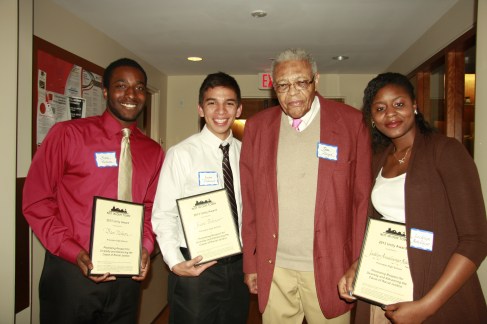
George Reeves, camp cook at Blairstown and grandfather of Jim Floyd, who graduated from Princeton in 1969. In the picture, he is shown with graduating PHS seniors Sam Nelson, Juan Polanco, and Jacklyn Adebayo, who received Unity Awards from Not in Our Town last month. (Floyd was so impressed by their accomplishments that he offered an additional gift toward their books at college.)
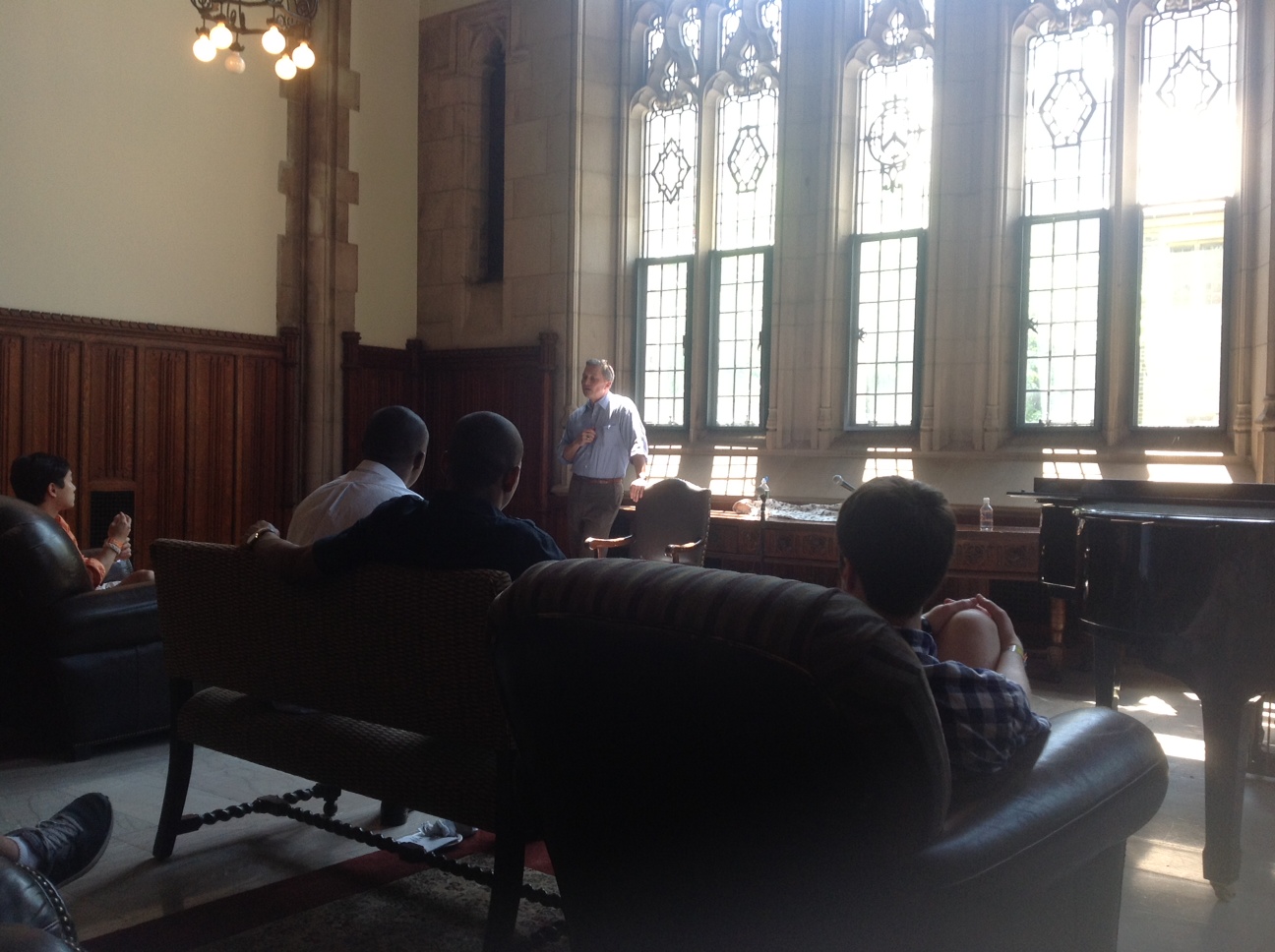
The speaker, Rivers, was one of three black students in a class of 700 in September, 1949. His account of the segregation and desegregation at this university, delivered at the Pan African Graduation in 2008, is an eye-opener. (This year’s event is Sunday, June 2 and I learned about this speech from a Facebook post from the Center for African American Studies.)
He concluded his speech in 2008 with appreciative words: But 55 years later, I count my blessings because I have been richly rewarded by unpredictable opportunities – and Princeton has changed.
On Commencement Eve, Not in Our Town will host Continuing Conversations on Race at Princeton Public Library. That’s Monday, June 4, at 7:30 p.m. In a discussion entitled Tongue Tied? Rehearse What to Say, we will talk about how to have a meaningful dialogue with people who have differing views about race and white privilege. You are invited.
Kuenne graduated from Princeton in 1985 and will follow Ed Zschau, in teaching the university’s very popular (highly competitive)High Tech Entrepreneurship class.
Read about the university’s success in commercializing technology in the cover story of this week’s U.S. 1 Newspaper.
See live broadcasts when Ben Bernanke speaks at Princeton University on June 2 at 2 p.m. and David Remnick speaks on Monday, June 3.
Here is the info I got from the Princeton University publicity folks: a summary of the graduation events leading up to and including Princeton’s 266th Commencement. I have deleted mentions of how to pick up journalist credentials and, no, I don’t plan to do that myself.
The Bernanke and Remnick speeches will be simulcaston Channel 27 for Comcast subscribers and Channel 21 for Verizon FIOS subscribers. The events also are scheduled to be webcast live and archived online for later viewing at www.princeton.edu/WebMedia/. For more information, visit the Commencement website at http://www.princeton.edu/commencement/events
—The Baccalaureate service will take place at 2 p.m. Sunday, June 2, in the University Chapel. The speaker will be Ben Bernanke, chairman of the Board of Governors of the U.S. Federal Reserve.
—The Class Day ceremony for seniors is set for 10:30 a.m. Monday, June 3, on Cannon Green (Jadwin Gym in the event of severe weather). The speaker will be David Remnick, editor of the New Yorker.
— The Hooding ceremony for advanced degree candidates will begin at 5 p.m. Monday, June 3, on Cannon Green (McCarter Theater in case of severe weather). The guest speaker is Sheryl WuDunn, a graduate from the Class of 1988.
—The Commencement program begins with the academic procession at10:20 a.m. Tuesday, June 4 on the front campus on Nassau Street. The University’s 266th Commencement ceremony is slated for 11 a.m. on the lawn in front of Nassau Hall (Jadwin Gym in the event of severe weather). Princeton President Shirley M. Tilghman will preside over the event and address the graduates. Several honorary degrees traditionally are conferred, but names are not announced until that day.
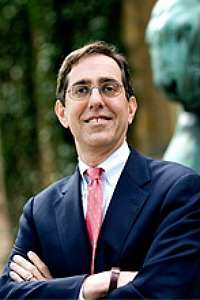
Princeton University’s new president, Christopher Eisgruber, tells an Associated Press reporter , Geoff Mulvihill, that Princeton is a warmer place than it used to be (thanks in part to more ‘inclusiveness’ among students). He lauds the idea of a liberal arts education versus a job training period. (Andrew Delbanco’s book, just out in paperback, College: What Was, Is, and Should Be, takes the same tack.)Yet Eisgruber regrets that current students can’t share the experiences he had when arrived as a freshman in 1979, and here I’m quoting Mulvihill: ‘Full faculty members sometimes served as discussion leaders for colleagues’ classes, it was more common for non-recruited athletes to walk on and join sports teams, and students weren’t so competitive from the moment they arrived on campus. But the last part, he said, is unlikely to change.’ In Not in Our Town discussions (NIOT holds discussions. ‘Continuing Conversations,’ on first Mondays at 7:30 p.m. at the Princeton Public Library), that very subject — aggressive competitiveness — has come up several times. These discussions are open to the public but are “private,” not divulged afterwards. However, one of the discussion moderators, Roberto Schiraldi, published several documents on the NIOT blog. Schiraldi has retired from a job as a Princeton University counselor. He shared an open letter to the current university president, Shirley Tilghman, He also posted part of a paper, A White Man on the REZ: “Higher” Education In A Culture of Fear: A Journey Through Alienation and Privilege to Healing. The question: Have student values of competition — getting the best grades and the best job — superseded humanistic values? The future president of Princeton University says he plans to “just listen” during his first year in office. If Eisgruber is listening, now is the time to speak.




 Princeton Comment