All posts by bfiggefox

Sara’s Advice to Future Brides

sara and dan

If you are planning a wedding, know someone who is planning a wedding, or remember your own wedding — read the last installment of Sara planning her wedding in U.S. 1. Fun, poignant, cogent.  Bent Spoon cupcakes instead of a wedding cake and remorse over no video.

John Springrose: “Prototype your imagination”

Sometimes a better chamberspeaker says what they said to a U.S. 1 reporter as published in the previous issue. Not so this time. Diccon Hyatt’s interview with John Springrose was way different from his talk at the Princeton Regional Chamber breakfast this morning. Springrose’s company (formerly inDimension3, now Philadelphia-based Koine) pioneers in 3D printers, more aptly named “rapid prototyping machines.

An IBM-er turned investment banker, Springrose  began with a “then and now” show of how innovation increases productivity, even though jobs are lost along the way. For instance, IBM’s first middle market computer, System 32, cost $40,000 and had only 5k of memory but in 1975 it could replace accounting functions. Checkers were replaced by self checkout and scans, tellers by ATMs, German auto workers by robots, and so on. “Innovation does lead to productivity,” he tells students, “and it forces us to think.” Be an innovator or run the risk of losing your job.

Examples of how a rapid prototyping machine can work: High school student gets an idea for jazzing up the wine drinking experience. Prints a prototype of a new wine holder, gets it manufactured in China, sells several hundred units on ebay for $40 each, total cost of each unit $1.89, accomplished this in less than a month. Product: a wine bottle holder that is lit from underneath, sending colors through a bottle of white wine. Cool. True story.

A plant “goes down” for lack of a part? A 3-D printer could make that part in a snap. A corporation could have a rapid prototype machine in the lobby and greet clients is greeted with a logo or miniature product from their company. Now that’s hospitality.

Three-D printers like toys can cost as little as $700 but, to be reliable, one should cost at least $5,000 for business use. Customers are mostly overseas. Springrose worries that the U.S. is getting left behind.

In addition to plastic, products can be in wood, metal — “anything that will melt.’ His industry today is where IBM’s System 32 computer was in 1975. “You give me the industry, I give you the use,” he offered.  “Prototype your imagination,” he challenges. “If you think about it, you can do it.”

As for the difference between the interview and the talk — the reporter dug into the not-so-successful early stage of Springrose’s company, when it was making cheap printers that were not reliable and got scathing online reviews. That’s why Springrose moved to the high end. More than 700 startups make 3 D printers but just three– including Koine — are working on business-quality tools.

Springrose has a very personal interest in the medical applications for his devices. He looks forward to the day when a rapid prototyping machine can print out a liver or a kidney. That’s because he has lived through a liver transplant. But printable organs won’t happen any time soon. Springrose came without a demo machine because — the day before, he demoed to doctors at Jefferson — and they broke the machine.

Photo: L to R, Grant Somerville (chamber program committee), John Springrose, Peter Crowley (chamber CEO).  

Amazing African Art in Soiree Auction

3 Luba Shankadi mask

This amazing Luba Shankadi mask will be in a live auction, at the African Soiree to benefit United Front Against Riverblindness. It starts at 5 p.m. on Saturday, March 21 at the Princeton Seminary and includes a buffet of African and international foods, entertainment, and an update from UFAR founder Daniel Shungu.

Anyone may buy items at the African marketplace, from 4:30 on, but you need to be at the dinner to participate in the Kuba art auction. Go to the United Front Against Riverblindness website for $70 tickets.

Other yummy items — this cowry-shell and beaded purse, a whimsica3 cowry shell and bead pursel double-entendre since cowry shells were a form of money. 

Traditional Congolese “Kuba” art was affected by influences from abroad that arrived during the era of colonization, but the individuality and variety of tribal customs has been preserved.

Below left, a modern sculpture. Below right, a museum quality headstand. And the textiles– my photos don’t do them justice so here is a link to a gallery.  Starting prices for the auction range from $100 to $500. If you can’t get there Saturday but want to bid… hmmm, shall I bid for you?

2 Luba Shankadi headrest

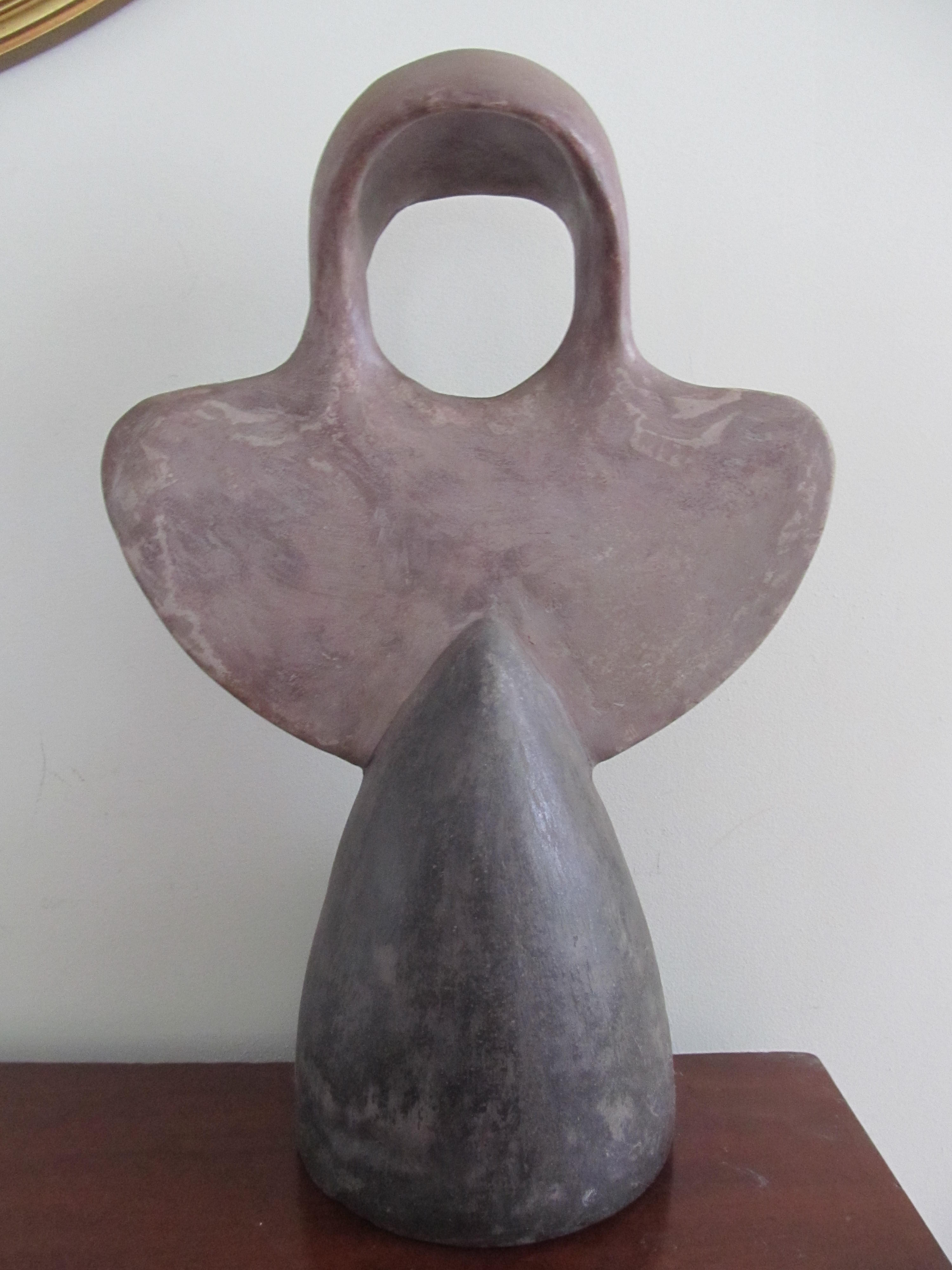
10 sculpture

Towers, teapots — and boathouses

Michael Graves in his studio DSC_0043 ret, 13 inches wide, credit Jon Naar, 2011 (1)

You probably read the New York Times  “designer of towers and teapots” obituary on Michael Graves, who died yesterday (3-12-15) at 80.

You probably did not see this excellent video of Grounds for Sculpture’s Tom Moran reminiscing about Graves, taken yesterday by Times of Trenton’s Michael Mancuso. Grounds for Sculpture has a 50-year Graves retrospective running through April 5.  Everybody is talking about their Michael Graves memory.

Early in my tenure at U.S. 1, Rich Rein assigned me to write a cover story on Graves. In the early days, U.S. 1 was a monthly, then biweekly, and cover stories ran at least 5,000 words.

The only way Graves could fit me into his schedule was for me to accompany him on a 6 a.m. Amtrak train to Washington, D.C., so Rein agreed to buy my business class ticket.

Bleary eyed, notebook equipped, I met the courtly Graves on the Princeton Junction platform. Two of the things he said stay with me today. He was telling about his upbringing. “I guess your mom was proud of your drawings and put them on the refrigerator?” I asked. His answer was . . . pause, “No.”

I thought that was a poignant comment and made a mental note to visibly appreciate my own children’s talents more.  At that point in his career, though the Humana building was up, and the Disney hotels were in the works,  no significant buildings carried the Graves signature in Princeton. Just a couple of house designs. It took a long time before a major Graves postmodern design, for the Arts Council of Princeton, would make it to the streets of his home town.

In any case, it was a heady moment for me. Until I joined the staff of U.S. 1 in 1987,  I had been a dance writer. I had interviewed famous dancers, but never an architect, let alone a famous architect.

Then, as  the train pulled into Philadelphia, Graves called my attention to the boathouses along the Schuylkill River. “Each is a different style, each a gem,” said Graves, of the 19th-century designs, noting that he assigned boathouse design to his Princeton classes.

Baltimore is my home town. I  got off in Baltimore and taxied to see my mother.  I made that train trip monthly for more than  a decade. Remembering that morning, I always craned my neck to catch a fleeting glimpse of the Schuylkill boathouses.

Photo by Jon Naar, U.S. 1, January 26, 2011.
That story “Called the Architect for the ’90s, but his work is invisible here,” was published on November 29, 1989, soon after U.S. 1 Newspaper had gone from a monthly to a biweekly. The paper has published many stories on Graves since that time, searchable in the archives.


Danielle Allen: canceled — but — wait!

The Princeton chamber lunch on Thursday with Danielle Allen has been cancelled, due to weather — but you have another chance to hear her.  She will speak at Labyrinth bookstore on Tuesday, March 10,  at 6 p.m. With Melissa Lane she will discuss Lane’s new book the “The Birth of Politics: Eight Greek and Roman Political Ideas and Why They Matter.”

Here is Diccon Hyatt’s interview with Allen in the current issue of U.S. 1  This interview focused on her reading of the Declaration of Independence, whereas I was more interested in her direct declaration of how she advocates for bridging cultural divides, as reported by Not in Our Town Princeton here.

The chamber lunch will not be rescheduled, but Allen will stay in Princeton till June. Perhaps she be persuaded to talk about intercultural dialogue here, before she goes to Harvard.


Danielle Allen: ‘interracial distrust’ vs ‘racism’

Danielle-Allen_605

Ask yourself, when you interact with a stranger from another race or background, whether you have treated them as you would a friend.

So said Danielle Allen, the luncheon speaker at the Princeton Regional Chamber on Thursday, March 5, at 11:30 p.m. In an interview with the Chicago Tribune, she explained the difference between the termInterracial distrust” and “racism.” As below:

“Interracial distrust does capture something missed by the word “racism.” Most of us use the word “racism” to denote the antipathy of white people to people of color. Though the word can equally well denote negative feelings that flow in other directions, we tend to restrict it to the attention “white” people pay to “colored” people.

“Interracial distrust,” in contrast, captures the fact that negative feelings flow all ways across multiple racial and ethnic lines. The world is too full to focus only on how one group of people perceives another group. I am interested in how each of us, individually, interacts with people who are different from us and whom we fear.”

Danielle Allen, a renowned author and co-editor, is currently at the Institute for Advanced Study but will soon leave Princeton for Harvard to be a professor and direct the Edmond. J. Safra Center for Ethics.  aiming to guide the center in a post-Ferguson direction.

She is chair of the Pulitzer Prize board, among other honors. Her topic for Thursday: Pursuing Happiness: What the Declaration of Independence Has to Teach Us About Human Flourishing.

The exact same kind of intercultural conversation that Allen espouses — it takes place in Princeton on first Mondays at the Princeton Public Library. Continuing Conversations on Race is March 2 and April 6 at 7 p.m.


Commentary on “Alan Turing: The Enigma”

2014 feb 1 leech, BC beard

For this post I asked my husband, George Fox, to read “Alan Turing: The Enigma” by Andrew Hodges and write about Turing’s Princeton connections. Princeton University Press had sent the book, issued at the same time as the The Imitation Game movie now playing at the Garden Theatre, but I didn’t have time to plow through all 768 pages. Like many engineers and programmers, George is a Turing admirer, and he obliged. As here:

In 1935 at age 22 Alan Turing was the first of his year group to be elected a Fellow at Cambridge and receive a fellowship which paid 300 pounds a year for three years. His focus area was mathematics and his first paper was a small improvement to a paper by John von Neumann.

John von Neumann happened to be spending a summer away from Princeton and gave a lecture course at Cambridge on the subject of ‘almost periodic functions’ – which provided Alan an opportunity to meet him.

Turing decided to apply for a visiting Fellowship at Princeton for the following year – 1936.

He did not receive the Princeton Fellowship but left for Princeton in September 1935 – spending 1936 and ’37 at Princeton.

The next year he was awarded the prestigious Procter Fellowship at Princeton. William Cooper Procter (of Procter and Gamble) was Princeton Class of 1883 and a significant benefactor to Princeton and to the Graduate College.  (The term Ivory Tower originates in the Song of Solomon but the Graduate Tower at Princeton is sometimes jokingly referred to as the Ivory Tower – a reference to William Procter.)

The birth of the modern computer

In the meantime (1935) Turing continued at Cambridge. He was a long distance runner and one day while running he had an inspiration to approach the mathematical problem of “provability of any mathematical assertion presented”.

Turing’s approach to the problem was published in 1936 in a paper titled “Computable Numbers.”

He had to abstract the quality of being determined and apply it to the manipulation of symbols.

His inspiration was to envision a machine which at any time would be one of a finite number of possible states with an exact determined behavior in each state. His inspiration was based on the typewriter which he had seen his mother using when he was a child.

He imagined the input to his machine as being a form of tape marked off into unit squares such that just one symbol could be written on any one square. Thus his theoretical machine was finitely defined but allowed an unlimited amount of space on which to work. The theoretical machine would scan a single square and could read, write and erase the symbol on the square but could only move one square to the left or right at a time.

The entire process could be done without human intervention.

All the information associated with a given machine could be written out as a table which completely defined the machine. There could be an infinite number of unique machines – each associated with only a single table.

Each table could be identified with a corresponding number. From this followed the idea of a universal machine which when presented with a given table could do the unique function associated with the table.

. In Computable Numbers Turing used binary numbers – which make it possible to represent all of the computable numbers as infinite sequences of 0’s and 1’s.

Turing began to think of Turing machines as comprised of combinations of electromagnetic relay switches. Off or on, 0 or 1, true or false. Thus the logical processes of Boolean algebra and binary arithmetic could be implemented in a physical process.

Alan Turing received his PhD from Princeton in June, 1938.

Turing and cryptanalysis

In 1937 while Turing was working on his PhD thesis at Princeton he became interested in cryptanalysis.

By 1937 Turing could see the growing tension with Germany and the value of code breaking.

The Enigma machine

The Enigma machine was an electro-mechanical rotor cipher machine invented by a German engineer at the end of World War I and was used for enciphering and deciphering secret messages.

Three Polish cryptologists are credited with reverse engineering the Enigma machine in 1932.

In 1939 British and French Intelligence were briefed on the Polish work with Enigma and were promised a Polish reconstructed Enigma. This machine became a vital basis for British continuation of the code breaking effort.

Alan Turing and his Universal Machine soon became deeply involved in British Intelligence and the continuing work in code breaking the Enigma.

The story of Turing’s work in breaking the German code is told in the movie “The Imitation Game.”

Note: Princeton Echo’s February issue features W. Barksdale Maynard‘s  complete account of Turing and the birth of computing in Princeton, first printed in the Princeton Alumni Weekly.

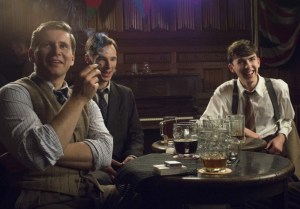
Above:  ALLEN “Downton Abbey” LEECH, BENEDICT CUMBERBATCH and MATTHEW BEARD star in THE IMITATION GAME
Photo by Jack English courtesy of Black Bear Pictures

The alternative energy czaress –Emily Carter, in charge of the new Andlinger Center at Princeton University —  has plenty of opinions on various aspects of global warming, as you might expect. But you might be surprised at what she says about hydrofracking. She’s the subject of the cover story, by Diccon Hyatt, in this week’s U.S. 1.

1-28 Cover & Front (1-7).indd