Category Archives: Around Town

Personal posts — some social justice (Not in Our Town), some faith-related (Princeton United Methodist Church), some I-can’t-keep-from-writing-this

Danielle Allen: ‘interracial distrust’ vs ‘racism’

Danielle-Allen_605

Ask yourself, when you interact with a stranger from another race or background, whether you have treated them as you would a friend.

So said Danielle Allen, the luncheon speaker at the Princeton Regional Chamber on Thursday, March 5, at 11:30 p.m. In an interview with the Chicago Tribune, she explained the difference between the termInterracial distrust” and “racism.” As below:

“Interracial distrust does capture something missed by the word “racism.” Most of us use the word “racism” to denote the antipathy of white people to people of color. Though the word can equally well denote negative feelings that flow in other directions, we tend to restrict it to the attention “white” people pay to “colored” people.

“Interracial distrust,” in contrast, captures the fact that negative feelings flow all ways across multiple racial and ethnic lines. The world is too full to focus only on how one group of people perceives another group. I am interested in how each of us, individually, interacts with people who are different from us and whom we fear.”

Danielle Allen, a renowned author and co-editor, is currently at the Institute for Advanced Study but will soon leave Princeton for Harvard to be a professor and direct the Edmond. J. Safra Center for Ethics.  aiming to guide the center in a post-Ferguson direction.

She is chair of the Pulitzer Prize board, among other honors. Her topic for Thursday: Pursuing Happiness: What the Declaration of Independence Has to Teach Us About Human Flourishing.

The exact same kind of intercultural conversation that Allen espouses — it takes place in Princeton on first Mondays at the Princeton Public Library. Continuing Conversations on Race is March 2 and April 6 at 7 p.m.


Commentary on “Alan Turing: The Enigma”

2014 feb 1 leech, BC beard

For this post I asked my husband, George Fox, to read “Alan Turing: The Enigma” by Andrew Hodges and write about Turing’s Princeton connections. Princeton University Press had sent the book, issued at the same time as the The Imitation Game movie now playing at the Garden Theatre, but I didn’t have time to plow through all 768 pages. Like many engineers and programmers, George is a Turing admirer, and he obliged. As here:

In 1935 at age 22 Alan Turing was the first of his year group to be elected a Fellow at Cambridge and receive a fellowship which paid 300 pounds a year for three years. His focus area was mathematics and his first paper was a small improvement to a paper by John von Neumann.

John von Neumann happened to be spending a summer away from Princeton and gave a lecture course at Cambridge on the subject of ‘almost periodic functions’ – which provided Alan an opportunity to meet him.

Turing decided to apply for a visiting Fellowship at Princeton for the following year – 1936.

He did not receive the Princeton Fellowship but left for Princeton in September 1935 – spending 1936 and ’37 at Princeton.

The next year he was awarded the prestigious Procter Fellowship at Princeton. William Cooper Procter (of Procter and Gamble) was Princeton Class of 1883 and a significant benefactor to Princeton and to the Graduate College.  (The term Ivory Tower originates in the Song of Solomon but the Graduate Tower at Princeton is sometimes jokingly referred to as the Ivory Tower – a reference to William Procter.)

The birth of the modern computer

In the meantime (1935) Turing continued at Cambridge. He was a long distance runner and one day while running he had an inspiration to approach the mathematical problem of “provability of any mathematical assertion presented”.

Turing’s approach to the problem was published in 1936 in a paper titled “Computable Numbers.”

He had to abstract the quality of being determined and apply it to the manipulation of symbols.

His inspiration was to envision a machine which at any time would be one of a finite number of possible states with an exact determined behavior in each state. His inspiration was based on the typewriter which he had seen his mother using when he was a child.

He imagined the input to his machine as being a form of tape marked off into unit squares such that just one symbol could be written on any one square. Thus his theoretical machine was finitely defined but allowed an unlimited amount of space on which to work. The theoretical machine would scan a single square and could read, write and erase the symbol on the square but could only move one square to the left or right at a time.

The entire process could be done without human intervention.

All the information associated with a given machine could be written out as a table which completely defined the machine. There could be an infinite number of unique machines – each associated with only a single table.

Each table could be identified with a corresponding number. From this followed the idea of a universal machine which when presented with a given table could do the unique function associated with the table.

. In Computable Numbers Turing used binary numbers – which make it possible to represent all of the computable numbers as infinite sequences of 0’s and 1’s.

Turing began to think of Turing machines as comprised of combinations of electromagnetic relay switches. Off or on, 0 or 1, true or false. Thus the logical processes of Boolean algebra and binary arithmetic could be implemented in a physical process.

Alan Turing received his PhD from Princeton in June, 1938.

Turing and cryptanalysis

In 1937 while Turing was working on his PhD thesis at Princeton he became interested in cryptanalysis.

By 1937 Turing could see the growing tension with Germany and the value of code breaking.

The Enigma machine

The Enigma machine was an electro-mechanical rotor cipher machine invented by a German engineer at the end of World War I and was used for enciphering and deciphering secret messages.

Three Polish cryptologists are credited with reverse engineering the Enigma machine in 1932.

In 1939 British and French Intelligence were briefed on the Polish work with Enigma and were promised a Polish reconstructed Enigma. This machine became a vital basis for British continuation of the code breaking effort.

Alan Turing and his Universal Machine soon became deeply involved in British Intelligence and the continuing work in code breaking the Enigma.

The story of Turing’s work in breaking the German code is told in the movie “The Imitation Game.”

Note: Princeton Echo’s February issue features W. Barksdale Maynard‘s  complete account of Turing and the birth of computing in Princeton, first printed in the Princeton Alumni Weekly.

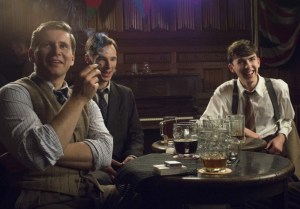
Above:  ALLEN “Downton Abbey” LEECH, BENEDICT CUMBERBATCH and MATTHEW BEARD star in THE IMITATION GAME
Photo by Jack English courtesy of Black Bear Pictures

Kate Newell: NJ Film Festival

Randy Now, a Cranbury mailman by day and a musician/DJ by night,
“seems to have brilliantly blundered into his role as promoter, persuading emerging bands to stop in Trenton en route between New York and Philadelphia.”

2015 1 29 riot on the dance floorKate Newell retells the story in this week’s U.S. 1 Newspaper when she reports on the New Jersey Film Festival, which opens Saturday, January 31. In the film, “Riot on the Dance Floor: The Story of Randy Now and City Gardens,” she recounts, “director Steve Tozzi reopens the doors of the legendary City Gardens in Trenton, letting out all the grit and glory trucked in by the remarkable club promoter Randy Now.”  Click here for her story. Also here’s an interview with former City Gardens bartender Jon Stewart

Randy Now now presents musicians at his new venue, the Man Cave in Bordentown.

Treasures in Your Button Box: next Monday

enamel man in hat $195 - CopyLarge 1 7/8 inch Battersea Pewter Racecar - face shank - FSBS 2004  $65coralene glass

Many of my friends know I collect buttons, and often they say “I have my mother’s buttons in a jar — would you look at them/” Now is your chance. Along with members of the New Jersey State Button Society, I will host a talk and hands-on demonstration, “Treasures in Your Button Box,” on Monday, January 19, 1 to 3 p.m., at Princeton United Methodist Church, Nassau Street at Vandeventer Avenue.

If you can attend, please tell me, so I can save you a seat! You may comment below or call 609-921-2774 or email duncanesque@yahoo.com. For parking information, go to http://www.PrincetonUMC.org. There will be a donation box.

You’ll see 19th century buttons made from china, shell and ivory, and also those made recently from modern materials — including rubber, plastic, celluloid, glass, and metal.  You will learn how to find and care for buttons that cost 25 cents, $25, or $250. If you bring your button box, the NJSBS collectors will tell you about them. And everyone will go home with new treasures.


Edgy (live) dance & film at the Garden Theatre

Something I did NOT expect: The Garden Theatre presents a LIVE dance-theater performance by DV8 Physical Theatre on Wednesday, January 14, at 7:30 p.m., repeating Sunday, January 25, 12:30 p.m. This National Theatre production is billed as for adults, read about it here.

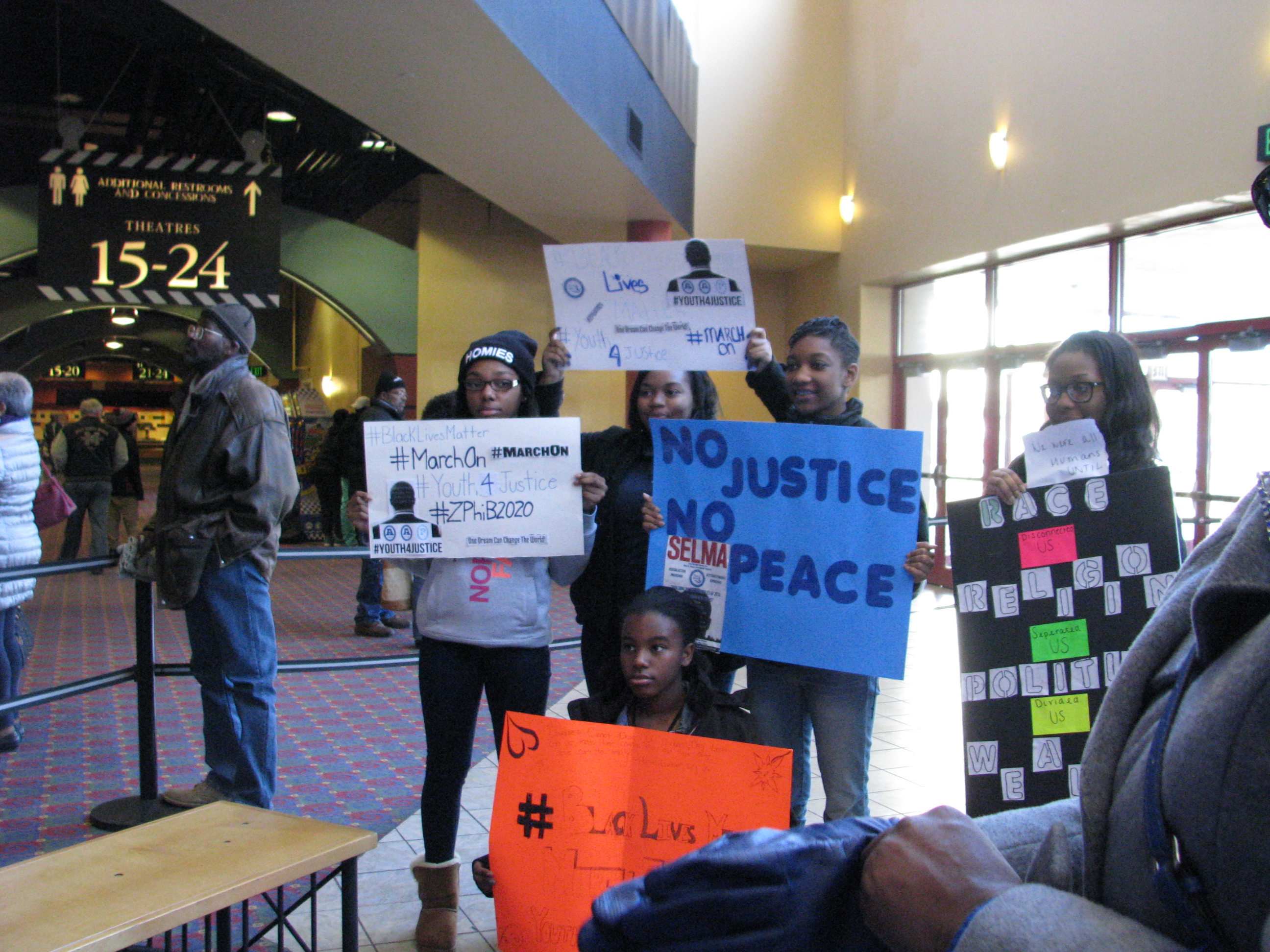
Current films at the Garden are Selma, which I saw in company with some youthful demonstrators at another theater on Saturday . Loved the script and the acting, and (though I am squeamish about it) the onscreen violence was handled well.

IMG_0188IMG_0200

Also the movie about Alan Turing.  Thanks to Princeton University Press who sent the Very Big Book that inspires the film. Spouse is plowing through it, likes it, and promises to provide a mini-review. Turing was surely a hero to my late cousin Ann.


Chaplains on the Medical Team


2015 jan tn04xxtedtaylor_2mm-(ZF-2175-91045-1-001)

For most of us the bookends of our lives – birth and death – take place with the support of a medical team outside the home. Chaplain Tedford J. Taylor, director of pastoral care & training at RWJ University Hospital Hamilton, will speak at a breakfast on Sunday, January 11, on how chaplains and others can offer pastoral companionship and support during these critical times.

The delicious hot breakfast, served by the United Methodist Men at Princeton United Methodist Church,  begins at 8 AM, followed by the program at 8:30.  A $5 donation for the meal is requested. Everyone is welcome!


Capstone for a Career, Strategy for the Next One

JaneTervooren2

Jane Tervooren has had multi-layered careers,  chronicled  in U.S. 1, most recently in a December 10 cover story by Diccon Hyatt. Tervooren’s departure from one fulfilling job to invest in an exciting new company was occasioned by a health event. As Hyatt describes, “surviving cancer is what led her to put a capstone on an 18-year career.”

Being diagnosed with a fatal disease, no matter what the outcome, inspires change.

Tervooren’s advice is appropriate for the New Year: “it’s never too late to re-invent yourself. Don’t settle if you’re unhappy in a relationship or a job. have the guts to make a change. If you are stuck, it’s because you feel stuck. People have options.

It’s a Good Story

Cornerstone Community Kitchen,  a partnership between Princeton United Methodist Church and the Trenton Area Soup Kitchen, has been in the news. On January 3 the Times of Trenton printed a photo essay by Martin Griff.  The previous week, West Windsor-Plainsboro News featured some volunteers from West Windsor on the front page. The Princeton Packet and Town Topics have also provided excellent coverage.

When I thank editors who run this story, I often get the same answer: “It’s a good story…”


Some white people admit to having privilege, some don’t. For both, here is a list of white privilege stories, personal histories.

Amidst the demonstrations of  “black lives matter” and “hands up don’t shoot” some of us who belong to Not in Our Town Princeton believe we should be educating  ourselves, then others, one by one. Until attitudes change, nothing will change.


Finance guru  William J. B. “Bill” Brady III  will speak Tuesday, December 9, 4:30 p.m. at the Friend Center. He is vice chairman, Credit Suisse Chairman, Global Technology Group. This Beckwith lecture is co-sponsored by the Bendheim Center and the Keller Center. A reception follows.

Brady was a hockey star at Princeton (Class of ’87). He has a low social media profile but was in the news for paying $26 million for two condos in the West Village. In that pink-colored building, Palazzo Chupi,  Richard Gere had been an owner.  Pink? Some say the building is red.