Category Archives: Uncategorized
This Morning, Contact Your Legislator
(This entry is an expanded version of what was posted on June 4).
This recession is a great time to be an entrepreneur, said Larry Chaityn, chapter president of an angel group (Keiretsu Forum NY Tri-State) because investors need somewhere to put their money.
“We have great deal flow,” he said, “because the Fortune 100 will be frozen for 18 months. You have an 18 month window.”
So many were eager to hear that message that the Forrestal Marriott had to set up extra tables for the New Jersey Entrepreneur Network meeting yesterday. Eighty people registered and another 2 dozen paid at the door for “A Gathering of Angels,” a round table with 7 angel funding groups.
It took about 45 minutes for each and every one of the attendees to introduce themselves, and, for me, that was really the best part of the program.
Such variety. Such inspiring stories, delivered in the 10 seconds allowed for each person. It was a good mix between entrepreneurs seeking funding (in some cases, seeking employees), investors seeking opportunities, and professional providers seeking clients.
Just two of the stories for now. I was thrilled to meet Daniel Kogan, CEO of Health World Web in Manhattan. He was standing around looking lonesome and my motherly instincts kicked in. A short chat about what he does in the e-health area (social networks for patient communities) and then, hmm, I thought, this is right down Esther Dyson’s alley. So I made a pitch for July 9, when the Princeton Chamber has inveigled Esther Dyson to speak. Turns out, yes, he had heard of Esther – in fact she is one of his advisors. What a great coincidence.
We sat together at lunch and on my other side was Sri P. Srivastava, founder of Clintech Research. I’d interviewed him for U.S. 1 but we’d never met, and he was eager to tell (and I was eager to hear of his success).
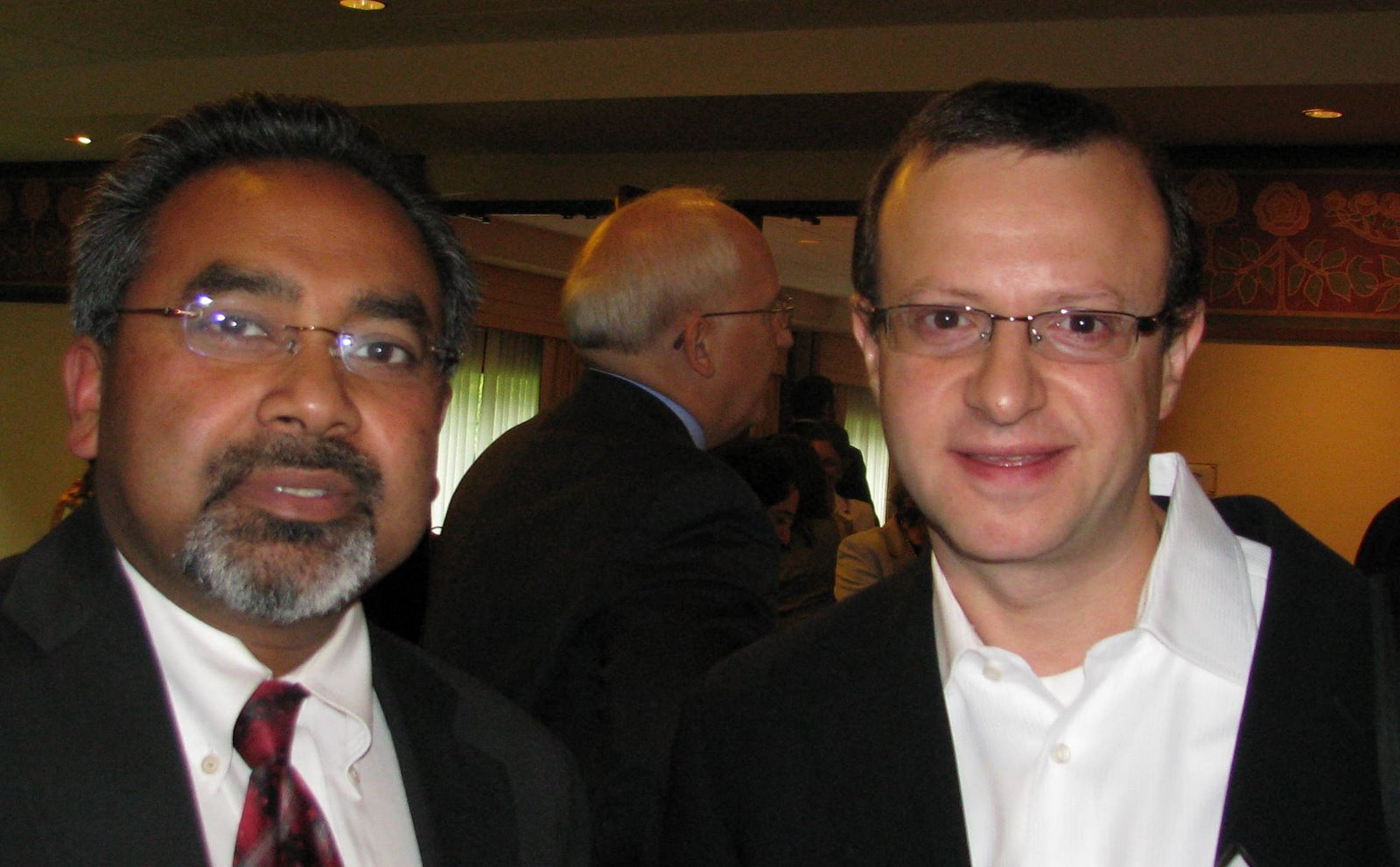
In the photo above, Srivastava is on the left, Kogan on the right. I snapped some candids that may help jog memories. Here is the link to the photos. (E-mail me or comment if you don’t want your photo or name used or if you weren’t IDed and want to be).
Lunch attendees were encouraged to contact their state legislators regarding A-3883 ACS, which expands New Jersey programs to encourage investments in small technology companies. According to the New Jersey Technology Council (http://www.njtc.org/) this bill was up for a vote on June 4, and it would increase state funding for tech businesses from $10 million to $15 million. In this recession, you ask? It doesn’t cost the state that much, because young tech businesses get to sell off their tax losses. (Apparently the bill did pass the committee, here is the link.)
Here are the angel speakers and their links:
Loren D. Danzis of Delaware Crossing Investor Group.
Joan Zief of Golden Seeds (female entrepreneurs).
Mario M. Casabona and Katherine O’Neill of JumpStart NJ Angel Network (mostly, but not all, in NJ, uses http://www.angelsoft.net for applications).
Larry Chaityn of Keiretsu Forum NY Tri-State
Christopher Starr of Mid-Atlantic Angel Group Funds.
David Twersky of Robin Hood Ventures and
Ellen Sandles of Tri-State Private Investors Network, the longest running and the only one who will “do” retail.
Other gleanings: If you meet one angel, you can connect with several, because they work together. A good place to meet them is at private airports, because — as risk takers — they are often pilots. If your business requires execution, don’t apply for angel money until you have some sales. And the oldie but goodie, angels invest where others fear to tread.
Once a reporter, always a reporter
In case you missed the NYT business section on Monday, a bunch of Star Ledger journalists are doing just what Richard Bilotti, ex publisher of the Times of Trenton, predicted would happen: Having lost their jobs, they couldn’t stop being reporters, so they set up shop in a library and started a website, www.newjerseynewsroom.com.
Hire a savvy woman to get the EMR show on the road
I think the Obama administration should tap Laverne H. Council to manage the transition to digital health records, also known as electronic medical records ( EMRs).
On November 14 I heard Council, CIO of Johnson & Johnson, speak at the New Jersey Technology Council‘s lunch. Based on that savvy but witty speech, I believe she has the smarts and people skills to inspire diverse groups – IT and medical – to come to agreement quickly.
Council came to J&J; by way of Ernst & Young and Dell. In a startlingly short time period she standardized all the IT departments in J&J;’s entrepreneurial culture. That included more than 200 operating companies and more than 3,500 information management employees with a budget of $1.6 billion. To whip or cajole everyone into line was an amazing feat.
“If you don’t standardize, you can’t digitize,” she said. We had to sell it as cost savings. If we digitize, we can innovate.”
Council is a long-time supporter of the idea that government should provide the standards for digitizing drug development. At the lunch, she pointed to the Vista software that the Veterans Administration developed. (For an account of a hospital that successfully used this software see Laura Landro’s article in the Wall Street Journal).
Council noted that the government has already spent a lot of money on this software. Unlike privately developed software, it doesn’t require lots of tweaking. Said Council: “Sellers of software don’t want you to pick it up and use it.”
It won’t be easy to stamp out errors, as the medical community eliminates paper, but then Gutenberg had his problems too. I found an amusing account of an early printer’s error on the blog e-patients.net. It seems that an errant typesetter left the word “not” out of the Seventh Commandment. All the Bibles from that press run read “Thou Shalt Commit Adultery” and the edition became known as “The Wicked Bible.”
Disclosure: I don’t know Laverne Council, have never interviewed her, have never even talked to her. This year the NJTC named her CIO of the year. I do try to follow the digital health record scene because I am interested in the progress of a Princeton-based personal health record firm, Zweena Health.
Drum Roll for Tomorrow’s Leaders


Former National Urban League head Hugh B. Price told the Princeton Chamber yesterday that one of the strategies for improving education is to increase and enhance the opportunities for student recognition. Prizes, awards, parades – they matter more than we would think, he said.
Looking back at the previous Sunday, when Not in Our Town gave out the 12th edition of its Interfaith Unity Awards, I get it. There wasn’t a dry eye when The Witherspoon Five, five eighth grade youths from John Witherspoon Middle School, gave their recitation of a poem by David E. Talbert on what it means to young black men for Barack Obama to be president. Evelyn Counts, JWMS counselor, had organized this for a Martin Luther King Day assembly, and the effort earned them the awards, a state citation, and a U.S. Savings Bond. (Pictured, Carole Krauthamer, left, with Evelyn Counts and the boys). JWMS Principal Bill Johnson has scheduled the Witherspoon Five to recite for a third time, at the Martin House graduation next week.
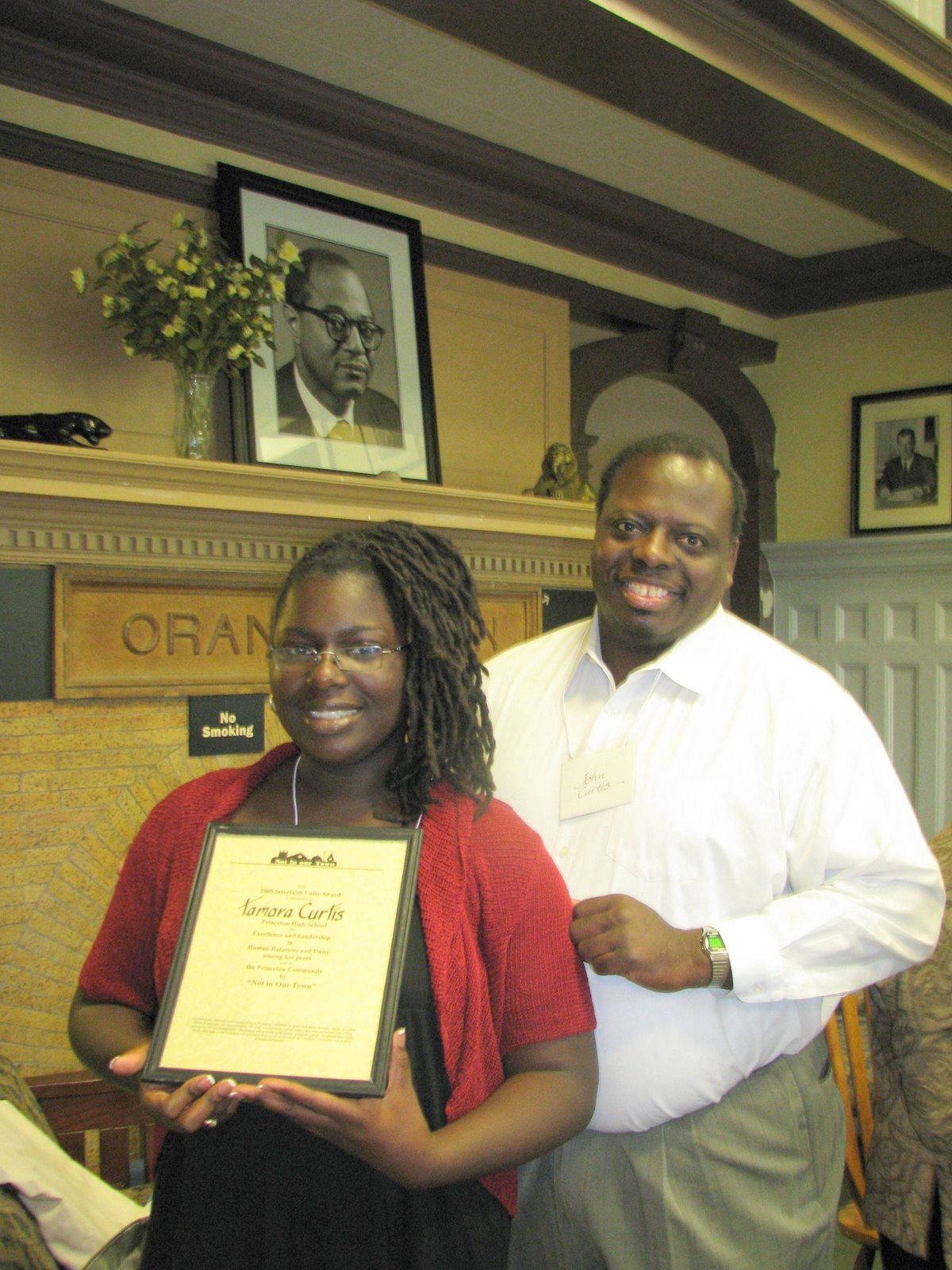
Not in Our Town is the interracial, interfaith social action group that recently presented a White Privilege workshop, co-sponsored by the Princeton Public Library, which brought 90 participants. NIOT also honored PHS seniors Moriah Akrong and Tamara Curtis as role models in their efforts to promote respect for diversity and to advance the cause of good race relations. (Tamara is pictured with her father, John Curtis, at the NIOT reception at the Carl Fields Center on the Princeton University Campus. For more photos, click here.)
Friends, family, and school officials spoke at length, affirming each of the honorees. The eighth graders, in particular, are at that perilous age when it is not a sure thing that they will succeed – and they are not afraid to wear their emotions on their sleeves. Jamal Williams’ mother (pictured with her sons by the banner) told of how, as a single mom, she was proud of her son and his friends, and it was especially poignant when Isaac Williams piped up to say how Jamal took care of him like a father.
Price, a product of the DC public schools (where his father was a doctor) plus Amherst and Yale, is a warm and witty speaker. He put much of his advice in his latest book, “Mobilizing the Community to Help Students Succeed.” He is in the first year of a five-year endowed visiting professorship at the Woodrow Wilson School, so he’ll also be around for the next couple of years. (He speaks in Trenton at Gallery 125 at 6:30 p.m. )
Another idea to celebrate achievement: herd the entire third grade of Trenton and surrounding area schools into the Thunder stadium or Sovereign Bank Arena and have them read a book in unison together. The only cost would be the buses and I bet that would be a popular corporate grant idea. Or give out a free bike, as they did in New Rochelle, to any youngster who read 50 books in a year. That year, 600 youngsters read 25 or more books.
“Children are hungry for this kind of engagement,” Price said. “The point is to create a drum roll for academic achievement, and engage the community in beating the drum.”
So — drum roll, please!
Save the Date: Esther Dyson here July 9

Esther Dyson, alternately dubbed the First Lady (or the Court Jester) of the Internet, will speak at the Princeton Chamber’s Thursday, July 9
writer, forecaster, and investor in emerging technologies, emerging
companies, and emerging markets, she grew up in Princeton and recently returned from five months training as a cosmonaut in Russia. Named by Forbes as one of the most powerful women in American business, she is the director of nine
start-ups and one publicly traded marketing conglomerate (WPP Group).
genomes, Russia. and space — and answer questions about anything from
investment strategies to health care.
Journalist’s Choice: Pitchforks & Burning Tar — or Kachingle?
Yes, I know, there is a dismal future for investigative journalism. Same for arts criticism. In a previous blog, I told about Richard Bilotti, former publisher of the Times of Trenton, pitching the unpleasant proposition that journalists should be entrepreneurial. Richard K. Rein’s U.S. 1 Newspaper column told of a panelist at Princeton University saying that experienced reporters were being replaced by youngsters making $35k a year. Neither option good.
Now, for the first time I hear (on public radio, natch) of some honest to goodness good ideas.
Studio 360’s Jonathan Mitchell talks to a freelance film critic, Mike D’Angelo, whose print jobs disappeared, but his readers chipped in to send him to Cannes.
That won’t pay the rent, but here’s another option: Visual art critic Lori Waxman has funding from the Warhol Foundation to travel around, set up her desk in museums and galleries, and write 20-minute on the spot reviews. It may not sound like much, but it would be an enormous boost to an un-reviewed artist to have a review from a bona fide critic.
Andras Szanto (pictured) of the Artnewspaper.com — quoted on the program — cites a bunch of likely ideas, ranging from the Carnegie Foundation’s Vartan Gregorian suggesting that foundations fund newspaper subscriptions for college students (replenishing future readers) — to foundations “tithing” one percent of their arts organization funds to support arts criticism, sort of like how builders, in Philadelphia, must dedicate a percentage of the building costs to artwork for that building.
Other ideas: “Community funded reporting” where people who want something investigated can make a tax deductible contribution to http://www.spot.us, with monies held in escrow until the sum is collected (usually under $1,000) and then the writer does the story. As Mitchell said, it’s the “pitchforks and burning tar” method.
Or think about “Kachingle, sprinkling change on the blogs you love.” You, the philanthropist, dedicate some amount per month ($5? $50) in advance. Automatically the money is distributed in proportion to the amount of time you spend at each of the sites.
This assumes the blogs you read have their Kachingle button in place. Note the absence of one here. I still haven’t even figured out how to count my stats. (Since this was posted, Steve Outing of Editor & Publisher has written about Kachingle’s competitors.)
Szanto agrees that it’s easier to find arts critics than investigative journalists, and it’s easy to agree. When U.S. 1 Newspaper went weekly more than 15 years ago, I was doing both business and arts reporting. We found a terrific arts editor, Nicole Plett, and I relinquished the arts portfolio – until now. As part of my volunteer gig here, I encourage myself to do dance reviews.
It’s the good and the bad that the arts attract writers willing to work for little or no money. Fellow members of the Dance Critics Association have been bemoaning that for years, and it’s worse now. Those with outside support (inherited money, spouse support, a day job, an academic job) are the ones who can afford to devote some serious time to arts writing, whether for print or online.
Having left my staff job, I can imagine doing dance reviews for free. I’m doing that here because I feel strongly that, since I’m trained to do it, and if I can possibly find the time, the dancers deserve that effort. And I’m willing to do basic reporting for free, to go to an event and spend a couple of hours reporting what was said, on the hope that the information will be useful to somebody in the future. But I can’t imagine doing a day-long or longer business reporting job for free. Thankfully, I can still get paid for that.
Hugh Price: Parades, Prizes, and Boot Camps?
It’s not enough to just throw money at a failing school. Think of something new, urges Hugh B. Price, former CEO of the National Urban League. Parades, prizes, and boot camps – they are just some of the suggestions that Price, former CEO of the National Urban League, is likely to put forward in a provocative talk on Wednesday, May 20, at7:30 p.m. at the Nassau Club. His topic: “Urban School Reform: Thinking – and Looking – Outside the Box.” Price’s talk is sponsored by the Princeton Chamber. Register at http://www.princetonchamber.org. (Full disclosure: I’m on the committee that scheduled this, and I’m basing this entry on his speeches and writings.)
Known for his turnaround of the National Urban League, which was faltering when he took over as CEO in 1994, Price is now a visiting scholar at Princeton University. A graduate of Amherst College and Yale Law School, he has been a vice president of the Rockefeller Foundation, a member of the editorial board of the New York Times. and has written several books, including the recent “Mobilizing the Community to Help Students Succeed.”
We need to think of innovative ways to inspire urban students, Price says. He proposes that New York City should sponsor a parade down the “canyon of heroes” for all the students who passed their state reading exam. “We have parades for every reason on earth except to celebrate children who are doing well in school.” He cites how Eleanor Horne, the vice president of Educational Testing Service, spoke at a SAT awareness rally in Columbia, South Carolina. (Horne happens to have been thePrinceton chamber’s honoree and luncheon speaker earlier this month.) You wouldn’t think that an SAT rally would be very popular, but 700 students came, and the event made national news.
Price is also a proponent of transferring the military’s expertise to public education. “The military spends more money understanding human development than any other institution on earth,” Price has said. “It has a well-deserved reputation for reaching, teaching, and developing young people who are rudderless.”
He wants public schools to find the generic equivalents to military values. It’s not for nothing that soldiers work for promotions — rewards and recognition are needed, says Price. Other needed values: a sense of belonging, teamwork, motivation, self discipline, structure and routine, accountability and consequences, safety and security, training and monitoring, and adhering demanding schedules. Most important: valuing and believing that every youngster can succeed. “The military doesn’t believe that its young people are stupid.” When he was at the Rockefeller Foundation, he challenged the National Guard to extend its development expertise to high school students. The result: In 25 years more than 81,000 youngsters have spent two weeks on a military base.
Regarding diversity, Price is worried about what ETS has called “The Perfect Storm.
a report that was explored in a workforce development seminar in February. As a Brookings Institution fellow, in response to a Supreme Court ruling, Price wrote, “The argument that integration and diversity comprise a compelling state interest is even more convincing in the case of public schools, because a vastly broader swath of future citizens would experience the advantages of diversity. Looking to the future, the U.S. economy will rely increasingly on minority workers, entrepreneurs, and taxpyaers who represent a growing segment of the population. Yet black and Latino pupils in particular are concentrated in the nation’s lowest performing schools with the least able teachers and most inadequate facilities…
Price has not been afraid to challenge the establishment, and I’m curious to learn what he will say about Trenton and Camden schools, versus the schools in more privileged municipalities. I grew up in Baltimore County, where all schools got the same amount of money, but I can’t imagine Princeton schools agreeing to merge with any neighboring school system, let alone Trenton‘s. Short of consolidation, what can we do to help educate everybody’s children, not just our own?
Saying Goodbye to Doris Duke
Not to be maudlin about it, but it was certainly sad when Doris Duke’s possessions, which I’d seen at Duke Farms, showed up sitting forlornly on tables at the Morristown Armory. Today was the first day of a two-day auction of the less valuable of Doris’s things. Now I know why my father-in-law didn’t want an auction.
There was her history, the facets of her complicated personality, from exquisite Asian art to bawdy cocktail glasses, from the gold penknife with the initials of the father she dearly loved (you can imagine her treasuring it in her drawer – didn’t some family member want this???) to an outdoor statue of a deer. From the oh-so-comfortable red chairs in her Theater room to four dilapidated cars.
Catalog prices were way low, perhaps to attract amateurs like me, and the bidding was sky high, partly because of the provenance. I tried my hand at a bid, choosing a huge Japanese drum that I could hardly lift, because I imagined Martha Graham beating on it as she gave dance lessons to Doris. Bidding started at 100, I got out at 400, and it sold for $11,500. That was the way it had gone all day, said a Chinese collector. At any other auction, he said, less than perfect pieces would go for low prices or unsold. There aren’t any bargains today, he said.
Most of what I covet goes on sale tomorrow, whereas today was Asian art and books. The Chinese collector said that, for the big New York auction, buyers came in from Asia, but today they were bidding on the Web and by phone, making preemptive bids and leapfrogging like crazy.
Nosing around, I talked to one of every kind: the elderly gentleman who had served on a trustee board with Doris duke at the community college, the African American couple and their young daughter who collect Lalique and Steuben, the former postman who is enamored with leather-bound books, the fashionable matron on an outing from New York, and, yes, the people who just liked Doris Duke and what she had stood for in the community.
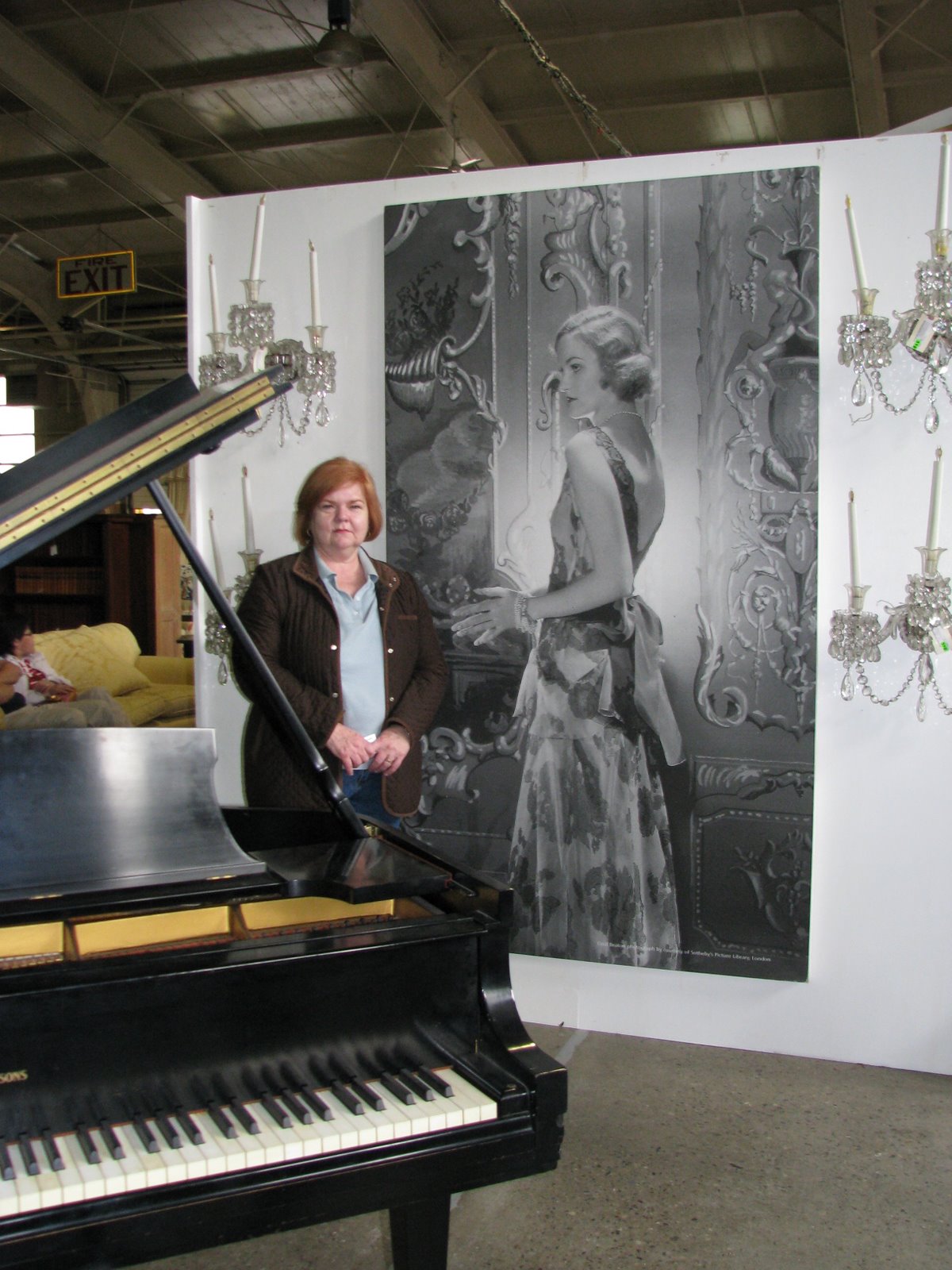
“I don’t know what they were thinking,” said the woman who lives in Hillsborough (pictured here). “It just doesn’t seem right that after all the wonderful things she did, that Miss Duke’s possessions should end up in the Morristown Armory.”
More stories should go with this, and perhaps I’ll have time, but meanwhile here is the link to the photos I took today. It’s worth going on Sunday, if only as a reminder that no matter how rich you are, you can’t take it with you, and all you really leave behind is your reputation.
Many a Heartwarming Story at Eden
Many a heartwarming story lies behind Eden Institute’s launch of a $7 million capital campaign tonight, April 30. Of that, $4 million will go to the sorely needed new school on University-owned land in Princeton Forrestal Center, and $3 million to set up an endowment fund to bridge the gap between what the state provides for adults with autism and the services that Eden provides.
Grateful parents turned out in force for this launch, and here is the link to some photos. The last photo shows just one of the success stories. It pictures one of the Eden staff members, Marge Brooks, a mother (Marge Schwallie) whose son is an adult client at Eden, and her son’s employer, Esther Ludwig, the manager of the DrJohns.com warehouse in Monroe. What a happy outcome.