
Is English an impediment?

From the Washington Post Plum Line: The Wall Street Journal editor’s nonchalance “suggests a lack of preparedness for what we may be facing.”
Here’s another from Greg Sargent’s Plum Line: If the headline does not convey the fact that Trump’s claim is in question or open to doubt, based on the known facts, then it is insufficiently informative.
For instance, the Bloomberg headline
“Trump seeks credit for 5,000 Sprint jobs already touted” is better than
the New York Times headline
“Trump Takes Credit for Sprint Plan to Add 5,000 Jobs in U.S.”
What about MY headline? In the movie “All the Way” Martin Luther King uses that idiom to describe President LBJ: “This president is going to have to deliver, or we will hold his feet to the fire.”
Start noticing headlines!

Joy Rosen’s Press Think blog (illustration above) explains what strategies journalists can use in a Trump administration. One idea:
Make common cause with scholars who have been there. Especially experts in authoritarianism and countries when democratic conditions have been undermined, so you know what to watch for— and report on. (Creeping authoritarianism is a beat: who do you have on it?)
So WHO at a New Jersey college is an expert on that? People who know, weigh in please!
Another idea: track Trump’s promises as here in the Washington Post and then get yourself on the radio to talk about them.
I have a suggestion for the ‘ordinary’ concerned citizen:Reporters are going to be looking for sources beyond the usual ones. If you know about a broken promise, a sullied right, a violation of civil rights — contact a reporter. If you don’t know a reporter, maybe I can help you find one. If you see something . . . say something.

Jesus Makes My Heart Rejoice — a simple quatrain that I my granddaughter, Jillian Fox, sing at our 50th anniversary service.
Hosanna! — a responsive hymn for Palm Sunday which would be challenging for most congregations except that Moravians are born knowing how to sing four part harmony.
Morning Star — traditionally sung at the Christmas Eve love feast by one child, responsively with the congregation.
Morning star, o cheering sight, ere thou camst how dark earth’s light. Jesus mine, in me shine, fill my heart with light divine…
It was a memorable Christmas Eve when our nine year old daughter was the soloist as this small church celebrated a Love Feast. After this hymn sung in darkness, ushers bring in trays of lighted beeswa x candles as the congregation sings Break Forth o Beauteous Heavenly Light.
So you can imagine my delight when I learned that the Chancel Choir at my church (Princeton United Methodist) will sing Morning Star n an arrangement by Helen Kemp at a Christmas concert on Sunday, December 18 at 5 p.m.. They previewed it in morning worship the week before.
Jesus mine, in me shine, fill my heart with light divine…
Two Princeton high schoolers — Winona Guo and Priya Vulchi — have published an important book that helps classroom teachers engage students in the often difficult to discuss subjects of race and ethnicity. They had help from experts in the field, but because it is chock full of personal stories of children, teenagers, and young adults, it’s a book that only teens could write. The Classroom Index, on sale for $20, will be discussed on Wednesday, December 14 at 6 p.m.  at Labyrinth Books (122 Nassau St, Princeton)
The 220 pages, with color illustrations, are organized beautifully for teachers — with intros on how to initiate discussion and clever indexes by tags. You can look for stories by identity (Latina, Asian, African American) or by topic (economic, interpersonal, aesthetic, residential, familial). Teachers can use this trove of stories to bring new layers of meaning for any subject from physics to phys ed.
I found it fascinating for a different reason.With so many different stories from so many different kinds of people, I can be a voyeur. I can find answers to the hard questions that I might be afraid to ask.
If I were to live in a place where everyone looks like me, it would be hard to be friends with someone different. And even those of us who live in a diverse community — maybe we can’t get up the nerve to talk about sensitive topics with someone of a different background.
Some of these stories are raw and pungent. Some poignant. Some funny. The authors put each story in a useful educational context. As here:
“My substitute teacher caught two girls talking to one another. He automatically thought the Hispanic girl was asking for help from the White girl, but it was actually the other way round.” The comment: “Racial stereotypes and prejudice go hand in hand. Disregarding the dimensionality of members of one race and placing them into constrained boxes can cause harmful psychological effects….the number of Hispanics enrolled in two- or four-year college has more than tripled since 1993.”
The panel will be moderated by the authors, Winona Guo and Priya Vulchi, co-founders of CHOOSE. They are also members of the Not in Our Town Princeton board. Dr. Ruha Benjamin, Not in Our Town’s lead racial literacy presenter will be on the panel, and she wrote the introduction. The panel also includes Superintendent of Schools Steve Cochrane, who supported the project. Also former Princeton High School English, History Supervisor John Anagbo, and Princeton University Associate Dean Khristina Gonzalez.
If you can’t go, buy the book to read and then give to a classroom teacher. The Princeton school have purchased many, but I’m betting there aren’t enough to go round. And then ask –is it being used?
Tom Sullivan, in a Princeton Partner s column, had some good ideas for how to deal with post-election stress in the workplace. “Use your company as an agent for change,” he says. Here is a five-step strategy, and for details on the first three, click through to the post/
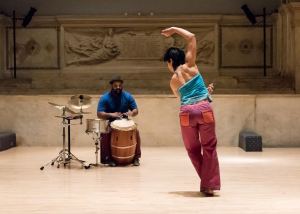
“I am inspired by lessons from the Caribbean that underscore creativity, resilience and the capacity for both resistance and celebration in the midst of difficulty,” says Alicia Diaz, a professional dancer who grew up in Princeton. She will participate in an unusual lecture demonstration this Friday afternoon at Princeton University. Entitled “Diasporic Body Grammar: an encounter of movements and words,” it will be December 2, 2 to 5:30 p.m. in the Wilson College Black Box Theater.
Asked, in an interview, whether she struggles with stereotypes, Diaz brought forward the stereotype of the “sassy Latina.” “Here ethnicity, gender, and sexuality come together to be consumed and dismissed at the same time. I struggle with rejecting the stereotype and its negative implications while also acknowledging and owning its potential power.”
Diaz, assistant professor of dance at the University of Richmond, will perform with her partner, Matthew Thornton. Here is a video of her work. Also participating will be a Brazilian artist, Antonio Nobrega. For information, contact Pedro Meira Monteiro pmeira@PRINCETON.EDU

“The rich fragrance of steaming beet borscht wafted into my apartment from Alexandra’s kitchen, awakening memories of my mother’s incomparable version of the famous Russian soup.”
Libby Zinman wrote this evocative account of living in the Harriet Bryan house for U.S. 1 Newspaper’s cover story this week. Describing her apartment there:
“It had been designed by architects whose esthetic sensibility had brought the outdoors into the apartment’s living quarters, allowing the woods, luxuriantly clothed in the red and golden leaves of autumn under a brilliant blue sky, to become part of my everyday life.”
Zinman had traveled widely and spent much of her professional life in Vietnam. She found wide diversity in her new home. “A milieu like this offered rich opportunities to understand other worlds and foreign cultures, a reality that also gently nudged us all to practice, more thoughtfully, the gentle art of tolerance every single day.”
She also covered how senior housing works in Princeton. In this sidebar, she testifies that “the Harriet Bryan House is one of the outstanding successes of Princeton Community Housing, which offers different programs for seniors unable to afford the increased cost of purchasing homes or renting apartments.”
That’s Princeton.
David Brooks spoke at the seminary. For my notes on his talk, click here.
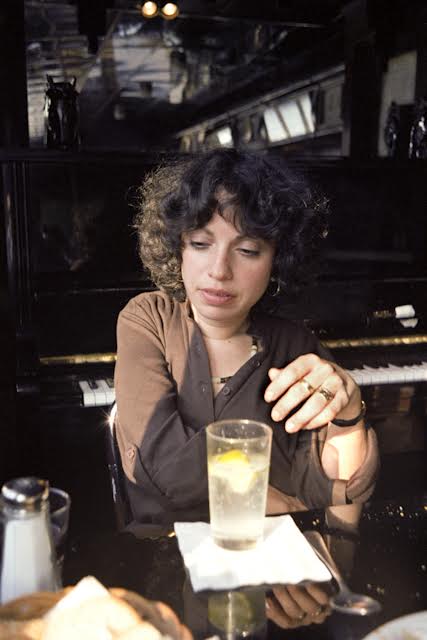
In these fraught moments, when some rejoice and many despair, I find comfort in Duncan Hartley’s photographs.
Hartley had pursued several careers. Most recently he was in charge of multimillion dollar donations for prestigious health institutions. But he began as a photojournalist in high school, and continued ‘shooting’ for 50 years. The photographer’s “eye” that could tell the story behind a face helped him breach the facade of deep-pocketed givers.
Hartley is readying a book of his New York photographs from then and now. “Then” was 1957 to the Bicentennial. “Now” is as recent as last September, when he revisited the Feast of San Gennaro for the umpteenth time. Paging through his work, online now at duncanhartley.com, I am struck by the contrasts between despair and joy even in the supposedly halcyon days. In black and white, a man in a tailored suit, nicely groomed, bent over bags of newspapers gleaned from trash cans. Passing by a legless veteran playing the accordion in Times Square are two haughty women, described by Hartley, in the language of e e cummings, as having “comfortable minds.”
In contrast to the harried commuters and the desolate staircase at Grand Central Station and the man with the Armagedon sign — is the 1974 photo of an African American couple — he in bell bottoms, she in a kilt skirt, facing each other, holding both hands, titled “Loving Couple Enraptured.” And the 1976 color image of a jubilant crowd in the bleacher ready to welcome the tall ships — with the twin towers in the background.
Hartley documents the passage of time. At Grand Central, men look up phone numbers in the display of telephone books and we people watch at the now defunct Empire Diner. He shows us how Little Italy – with Canola Man and Pretzel Man — has gradually accessed Chinatown, by picturing a gaggle of girls from different ethnic origins and an elderly Asian couple lost in the San Gennaro crowd.
I take photos. I come from a family that placed a high value on photography. I grew up in Baltimore, where we revered the work of A. Aubrey Bodine. I like to take photographs of people. I like to think I have “an eye” for a good shot. And I am in complete awe of these pictures, each with its compelling story.
He shows us poignant. He shows us despair. He shows me that — no matter how fraught I think today’s political situation is — life will go on. New York will go on. We will all get through this.
Full disclosure: the photographer is a friend and compatriot at my church. But I am among the last and least in a queue of experts and luminaries who offer fulsome praise for his work.
 Princeton Comment