Here’s a shout-out to attorney Liz Zuckerman, interviewed by Diccon Hyatt for this week’s U.S. 1 Newspaper cover story on the new overtime laws, read it here. It’s a complicated issue, explained well, with the “opposite side” presented well by John Sarno of the Employer Association of New Jersey.
Craig Kramer works for healthcare firm Janssen, but he and his wife had their own personal health challenge: Their daughter suffered from an eating disorder. Kramer speaks at the Princeton Regional Chamber luncheon on Thursday, June 2, 11:30 a.m. at the Forrestal Marriott. His topic: The business case for transforming mental health.
Speaking That Connects, owned by Eileen N. Sinett, was named Small Business of the Year at today’s breakfast held by the Plainsboro Business Partnership, part of the Princeton Regional Chamber. “Well deserved” was the often-heard kudo for the former chairman of the PBP who coaches professionals and corporate teams to enhance their communication and presentation performance and dedicates Monday nights to facilitating a Conversational ESL group at Plainsboro Public Library.
Mayor Peter Cantu spoke, and though you’ll get better detail from Vincent Xu in the next edition of West Windsor-Plainsboro News, here are some of the facts I was surprised to learn:
More than 50 percent of the township is open space
Plainsboro has an record-holding tax collection record– 99.6 percent, contributing to its AAA bond rating
Child care and assisted living centers will break ground near the hospital this year, and a 300-unit senior housing development i planned.
Forrestal Village, ever struggling, could get 395 apartments with a “unique design.”
New retailers will be Panera, Five Guys, and a pet supply store but alas — no grocery store is imminent.
Eight major companies have earned the state Good Neighbor award, with Sandoz the most recent.
Gym rats rejoice, a 25,000 foot health spa is going through the approval process.
And — considering that Plainsboro ranks 5th nationally in “diversity” (translated, that means a population that is not primarily Caucasian) — it’s not surprising that the newest addition to the athletic scene will be a regulation cricket field. According to one sports reporter, cricket is the new soccer. A “capital commitment” has been made and, meanwhile, the next nearest field seems to be in North Brunswick.
Rocky Romeo will speak on “Power Networking and New Business Development for Communications Professionals: How to Open the Door to New Opportunities,” and the eve
ning includes refreshments, networking, and a moderated panel discussion about where the opportunities are – from freelance work to full-time jobs for communications professionals. The panel will include Julia Zauner, Director, Digital Strategy & Corporate Communications at Springpoint Senior Living, Laura Virili, Social Media Brand Expert, and Frank D. Gómez, Strategic Alliances-Public Affairs Executive, Educational Testing Service. Larry Trink is the NJ CAMA president.
NJ CAMA was founded in 1986, the year I began at U.S. 1, and I remember its meetings as lively, fun, and inexpensive. Sadly, I can’t go to this one — but maybe you can.
When David Sedaris launched his annual speaking tour tonight, standing room only at McCarter (Wednesday), the line for book signing snaked around corners. Asked about the election, his off-the-cuff answer about Trump, paraphrased:
“It’s as if he looked at who wasn’t being pandered to — the stupidest people in America weren’t being pandered to.” Sedaris said, pointing out that at least Trump gives plain answers rather than politician-runaround. “I think he dominated the news so long that people were tired of him.”
Patrick Murray will opine on the same subject on Thursday, April 7 at the Princeton Regional Chamber. To find out what folks are really thinking about politicians like Trump, says Murray, eavesdrop in a diner. Murray is quoted in Michele Alperin’s U.S. 1 cover story here. Murray heads the Monmouth University Polling Institute, which is still in the game of political prognosticating, an arena in which — surprisingly — Gallup has left. Here is why.
For this occasion, Sedaris wore culottes. What would Trump say?
Kudos to Karen L. Johnson CPA CGMA PMP for filling in for me to file this guest post. For more economic input, the Princeton Regional Chamber holds its economic and technical summit on Tuesday, March 8. When he was still at BlackRock, Doll was the keynote speaker.
A man of finance, family and faith spoke at the Princeton Chamber’s luncheon on March 3. Fresh from CNBC’s Squawk Box, Robert Doll, senior portfolio manager and chief equity strategist at Nuveen Asset Management, sees one factor in the purpose identified by some media: financial entertainment and not financial education, in an environment where bad news sells. What was wrong with the market? A fear funk.
What’s really the biggest risk to the market? That we will import deflation from the rest of the world. Doll suggests we keep in mind that the US is the most isolated economy in the world, 87% domestic, and we’re letting the tail, 13%, wag the dog. Consider first some positive tailwinds for the US consumer, such as the biggest generation of jobs in history over the last five calendar years, with 89% full-time, along with average earning up 2.5%, to be 3% by the end of 2016.
Look too at corporate balance sheets, where debt has been paid down, and the powerful impact of oil going from $100/barrel down to $30. As of now, we’re spending a third and saving two-thirds. Add up those gas savings and it’s “Time for vacation, honey.”
Hand-wringers are citing the decline of manufacturing. We had Cassandras when we moved from agriculture to manufacturing, just as we do now as the economy has moved from manufacturing to technology. And keep in mind our 2.4% growth, last year and this.
What about Washington? There’s the good, bad and the ugly. [my phrase, not his] The Good: over about the last 7 years, the Federal deficit has collapsed from $1.4 trillion to $0.4 trillion. The Bad: Corporate America has the highest marginal tax rate in the world. The Ugly?
Is this choir director (Doll is listed as such on the website of Stone Hill Church) preaching to the choir? Hard to tell. What’s sure — it was education and entertainment as he captivated the full house at the Forrestal Marriott.
He wasn’t a funny guy but he did have amusing parts – and he did have the undivided attention of the audience — which puts into question CNBC Squawk Box’s contention that being entertaining means you can’t also have an educational purpose.
So get rid of the fear funk. Don’t confuse the stock market and the economy.
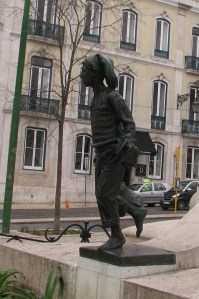
In Lisbon, Portugal, a delivery boy is featured on the monument for newspaper magnate Eduardo Coelho
I couldn’t help but smile when I saw that Boston Globe reporters, frustrated by delivery problems, volunteered to get out and actually deliver Sunday’s paper themselves. Article here, courtesy of my Twitter feed. In 1986, for my first week at U.S. 1, everyone on the staff (plus the freelancers) loaded up with papers and headed out from Mapleton Road to their delivery routes.
As Rich Rein used to say . . . “When you deliver, you get to know your readers.” Our deliverers are also paid to be reporters — to note when companies come and go. Even when we moved “up” to Roszel Road, cheerful willingness to pitch in on delivery was a condition of employment.
I couldn’t help but be sad when I realized that the Globe fired 600 people who worked for its former delivery service. Yes they hired 600 more but the previous workers were surely living on the margins, some struggling to learn a new language in a new country. You don’t work midnight to eight, putting miles and miles on your car or your feet, unless you really need the money.
Then I remembered how gratifying it was for those of us who wrote the paper to actually deliver a paper that is warmly welcomed by its readers. In virtually all the buildings, I would be greeted by — “Oh good, U.S. 1 is here, thank you!”
I’m against McMansions as much or more than anybody (see this U.S. 1 story), but I have big questions about new rules being rushed through Princeton Council that aim to curb them.
Says architect Marina Rubina, who lives in the Witherspoon-Jackson neighborhood, “Our elected officials decided to take on the issue of “tear downs and McMansions” and solve it in one month without thinking it through or giving the public a chance to weigh in. The problem is that what they are proposing won’t stop McMansions, but will hurt a lot of people and lower income people much more than others.”
Unfocused restrictions on FAR will have some effect on reducing the numbers of ‘McMansions’, but it will also make it harder for people to build rooms for aging parents, or to sell their homes at full value. A stealth downzoning appears to be underway, in the rush to be seen to be doing something about development that many residents consider ‘ugly’ or ‘not fitting the neighborhood’. But for many homeowners, the new restrictions may prove costly in the long-term.
It’s complicated. I can’t decide. But we can all ask Princeton Council to take more time to decide. Council meets at 7 pm tonight (November 30) on another matter and is supposed to vote on Monday, December 7. Come to either meeting or send a note to somebody on council with the message “WAIT . . .. LISTEN” before you take a vote.
Quoted in a U.S. 1 Newspaper story by Michele Alperin, Kubacki says, “People are afraid that if you do things outside of the norm and you fail, they will get criticized and fired. That is why marketing tends to be safe, and safe doesn’t always work.”
 reakfast held by the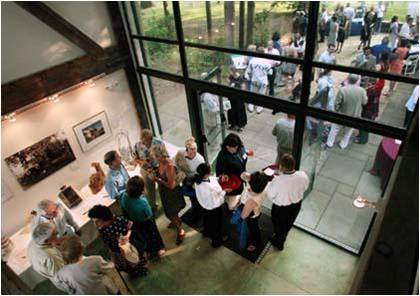
 A man of finance, family and faith spoke at the Princeton Chamber’s luncheon on March 3. Fresh from

 Princeton Comment