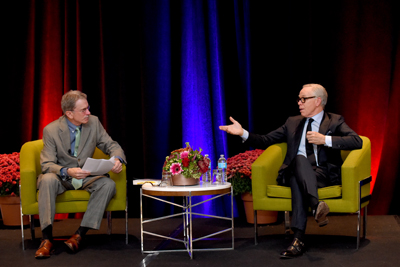
Rich Rein and Tommy Hilfiger (photo by DiGiovanni Photography)
I have my own story about meeting a celebrity at the Princeton Chamber event at the Hyatt but Rich Rein’s is better.
He interviewed Tommy Hilfiger about his book American Dreamer and muses on that experience in his U.S. 1 Newspaper column last Wednesday. .
For the occasion, Rein had outfitted himself in a T.H. shirt and tie from Macy’s, but apparently that wasn’t enough.
You’ll have to ask me in person about my own embarrassing story, it’s not something I want in print. But I can heap praise on the spectacularly displayed goodies at the VIP reception
and the enthusiastic crowd of 400 that filled the Hyatt ballroom to capacity. Fashion students from Philadelphia, attending on free tickets but buying Hilfiger’s book, were thrilled to be there, along with many many on the Chamber email list, some U.S. 1 readers, and people who heard about it on the radio (I polled those standing in the booksigning line that curled around the room.)
To my somewhat surprise, since I am not a fashionista, I liked the book, a tale of derring do. I particularly liked the part where one of his buddies recognized that the river would flood the town of Elmira, so they enlisted everybody — family and fellow high school students — to move inventory from the basement to the top floor. After the flood, the Hilfiger stock was the only dry clothing for sale in submerged Elmira. Everybody — grandparents and teens alike — bought and wore his tie-dyed shirts.
Hilfiger’s is a Horatio Alger story of overcoming — not poverty, but dyslexia. It’s just amazing how talent and focus — and maybe a little luck and grace — can conquer disability.
You’ll have to read Rein on the top two buttons. I can’t tell it as well as he did.
High Level Networking: Tommy Hilfiger (in pinstripes) greets Princeton Regional Chamber CEO and board chairman Richard Coyne (Alice Barfield looking on) at the Hyatt ‘s VIP reception downstairs before he was interviewed upstairs by Richard K. Rein for 400 eager fans about his book “American Dreamer.”
Election morning — how did I do this? – I am scheduled to speak at 7 a.m. at the Capital Networking Group at my own church, Princeton United Methodist, at Nassau & Vandeventer.
Upstairs, the church is a polling place for District 10. Downstairs, in Fellowship Hall, I guarantee no politics. Only stories.
For the entrepreneurs in this group, which meets every Tuesday morning for breakfast (good bagels!)
The items below popped up in my news feed this week and may find their way into the stories I’ll tell.
The first seven words matter. In person, you may make your first impression in a millisecond, the blink of an eye, according to Princeton psychologists Janine Willis and Alexander Todorov (Association for Psychological Science) July, 2006.
“If you can’t be funny, be interesting.” Harold Ross, founder of The New Yorker magazine, from The Writer’s Almanac.
“If it’s familiar but has a certain something that sets it apart, you’ve got a hit,’ Tommy Hilfiger, American Dreamer, p.131
“The pay phone measured time in quarters, the Internet in taps and clicks.” In There’s Nobody Here by That Name, by Steve Bryant via Medium Daily Digest.
SO, you might ask, why did I use my photo of Tommy Hilfiger for this post?
BECAUSE I COULD! Any good PR person knows never to miss a chance to tag along on celebrity coat tails, however slim the connection.
Of course — all the media attention to a certain celebrity is what got us to this point in the election cycle.
My dilemma about 11 Green Street was explained well by Vincent Xu in this edition of the Princeton Echo . Can the historic preservation ordinance ‘save’ the Witherspoon Jackson neighborhood.
Rev. Dr. DeForest “Buster” Soaries at Princeton Regional Chamber, photo by Victoria Hurley-Schubert of Creative Marketing Alliance @CMA @dbSoaries @princetonregion
Engaging and inspiring, Rev. Dr. “Buster” Soaries simultaneously aggrandized his Princeton chamber listeners and challenged them. The pastor of the 2,000-seat First Baptist Church of Lincoln Gardens dealt with the latest Trumpisms right away. “This country has survived even more turbulent times,” he reassured. “Our strength is not only in the election of candidates, but also in our infrastructure of voluntary associations to preserve the integrity of our society — people who recognize others’ talents and are willing to share their resources, to invest in who we have been and who we will become.”
Partnerships are key, he said, referring to podium banners touting the chamber’s gold, silver, and bronze sponsors. “To be who we are called to be in history, we have to prove that the freedoms we enjoy work for everybody. To say ‘what’s mine is yours if you need it.’ By giving to others, we can be who we say we are.“
To combat “a Bermuda triangle of deprivation” three decades ago, he partnered with, for instance, United Jersey Bank’s Joe Semrod to transform the “worst public housing I have ever seen in my life” into what now looks like private condos. But he might also partner with current and former gang leaders to muster support for community change.
Three requirements for successful partnerships:
Partnerships must be relational not just transactional. It’s not just writing checks. Without spending extra money, a hospital can move its health screening facilities to a needy community. Police offers can visit schools. People can tutor other people’s children.
Partnerships must be horizontal. Those with money should trust the knowledge and talent that are in the community. For instance, a Thanksgiving turkey giveaway went awry because the people standing in line were just reselling the food. The ‘respectable’ church ladies needed to consult with those less ‘respectable’ to get their charity to the right people.
Partnerships must be sustainable, not seasonal. “As political seasons change, there go our projects. The government can fix a street but it can’t fix a broken heart. We are nurtured by the neighborhood we build. We need to focus on what it takes to build each other up.”
Helping people to live within their means is an important part of ministry, says Soaries, who believes that churches should teach people how to budget. He learned the hard way. As a young man he was a big spender, buying a Cadillac because he assumed preachers drove expensive cars and spending for expensive clothes. “I had more money on my back then I had in my bank account.”
Don’t blame government for the legacy of poverty, he says. “We could raise the minimum wage to $200 an hour and some people will still be broke.” Instead, switch from premium cable to basic cable and use the extra $75 for a life insurance policy. “Then you will close the gap for your children.”
Ken Kamen of Mercadian asked how to help people change their spending ways. “We live in a culture of entitlement that thinks fantasy and reality are twins,” Soaries said. In the first three chapters of his book, Breaking Free from Financial Slavery, “I trick people into confessing that they have a problem.”
Phil Slater of Omega Financial Services , a new chamber member at the Carnegie Center, revealed his company might be hiring loan processors.
Chip Jerry, Audrey Yeager and James O’Neill (Sam’s Club)
And I was delighted to introduce Audrey Yeager, new on the staff of the Princeton Symphony, to Chip Jerry, brother of the late Philip Jerry, — a Joffrey Ballet star who spent part of his career at American Repertory Ballet/Princeton Ballet School — where Audrey studied when as a student at Rider. It was a serendipitous way to welcome her to Princeton’s business community.
A quick way to cure a hangover, a new medical imaging technique, an innovation in American Sign Language, a hackathon tool kit, a robot sous chef, and a fashion discovery engine — some of the best and brightest Princeton undergraduates are launching exciting startups. List here.
They’ve been working all summer in the Keller Lab, and their Demo Day in Princeton is Tuesday, August 9, 2:30 p.m. at the Friend Center. You need to register!
I can’t attend. If anyone who reads this can go, and wants to write it up for this blog, I’d welcome that. If you don’t have my email, put in the comments that you’d be willing to be a guest blogger.
A shout out to Telequest who produced this great video for Isles on how to fight dust with effective house cleaning methods. Watch it if you need motivation to use a vacuum cleaner more often. I just found the video and like the tip about getting an extra damp mop bucket instead of using the kitchen sink.
HERE’S A DUAL POST — FROM ME AND GUEST WRITER EILEEN N. SINETT. EILEEN GOES FIRST...
“Stories Still Matter: In Print and Online” was the theme of the Princeton Chamber’s Business before Business breakfast networking meeting this morning. Richard K. Rein, founding editor of U.S. 1 Newspaper, shared stories that only dig-deeper news people would know. His speech was informative, entertaining and well-delivered.
As a Speech Coach, I was especially taken by his smart opening which was void of verbiage. Yes, Rein opened with silence, four seconds worth (as the audience later learned). He created the “verbal white space”™ that level-sets audience attention and highlights opening remarks. Silence is often scary for societies that talk a lot.I noticed one or two people in the audience getting antsy after 2 seconds of quiet, but saw the other 90 people in the audience palpably poised to listen and patiently await the stories that would soon unfold.
Starting a speech with silence makes perfect sense. It can feel risky and uncomfortable at first, but the positive impact is quite rewarding. Silence is to speech, what margins are to writing. The ability to be present without words in speaking and in life, can be a strong differentiator.
Narratives can change opinions, said Rein, citing the late John Henderson (a former reporter who built his real estate business on the lyrical descriptions of his listings) and Jerry Fennelly, who issues real estate analytics in story form. Long form narratives can also clarify the thinking of the writer (as well as the of the reader) and help establish credibility for both writer and subject.
Barbara Fox with Richard K. Rein and freelancer Michele Alperin
Then it was story time: Rein told of almost-missed stories about Colin Carpi, lawyer Bruce Afran, and Muhammed Ali (as written by himself and fellow Princetonian sports writer Frank Deford) and he related a bit of gossip about Larry L. King. (Based on observing Ted Kennedy at a party, King vowed to do everything he could to keep that Kennedy from being president.)
In a lively Q&A Irv Urken asked about the value of print in a digital world: Brandishing the articles he used in his speech, he said, “you don’t have to worry about your batteries going down.” He also cited “the science of touch” and suggested that some presentations and pictures “require a bigger screen.” That print media has a limited space means that somebody must edit it to fit the space, and when editors get to do more than just run a spell check, readers read more carefully. Then Rein gave a shout out to Urken’s offspring who have media careers — one works for Newsweek and Street, the other for Yahoo.
Hurley-Schubert
Former reporter Vickie Hurley-Schubert (now with Creative Marketing Alliance) asked which was his favorite story. Hard to pick, but Rein cited one early in his career, for New Jersey Monthly, on the scandal surrounding Circle of Friends.
I liked his answer about whether the media has a liberal bias: “When you spend time with people, you begin to assimilate their values. Media does have an ego, but it also bends over backwards to present other points of view.”
So — down with ‘scooplets,’ which, as Rein explained, are what Jill Abramson calls the focus on quick content that spawned $1.9 billion in free publicity to the Trump campaign.
Up with narrative journalism. Long live the long form stories in the likes of U.S. 1 and Princeton Echo.
Rich Rein (Princeton, Class of ’69) will speak at the Princeton chamber breakfast on Wednesday. I’m looking forward to my former boss telling stories old and new. And I also like the tradition, at the breakfasts, that everyone gets to stand up and introduce themselves. Perhaps I’ll see you there?
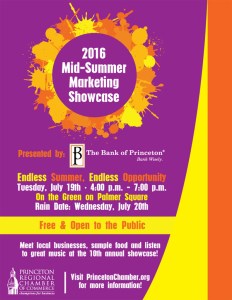
The day before (Tuesday) is the chamber’s Midsummer Marketing Showcase starting at 4 p.m. In past year’s it’s been plagued with weather cancellations, but predictions are good for tomorrow. And it’s one of my favorite Princeton Regional Chamber events, in part because it’s free.
Jackson Bush (left) and Cris Hrabar ‘at the ready’ for Open Door Valet
Two problems solved with one pop-up business — where can townies can park at the eatery nexus near Hoagie Haven, and where can tourists can park downtown?. Douglas English founded the Philadelphia-based Open Door Valet in 20o9 and Chris Hrabar (above right) joined him a year later. His car parkers serve such restaurants as the Peacock Inn and Eno Terra and he opened this freestanding location of Open Door Valet in mid June.
Park your car yourself across from the Ivy Inn (the parking lot behind 245 Nassau Street) and pay $5. (What? no more snitching a parking place to pick up a Number One?) Valet park at Hinds Plaza and it costs you $15, $10 on a slow night like July 2 when two stones-throw-away garages had lots of space.
Even better deal: Park it yourself, go pub hopping or people watching, and “text-2-retrieve,” they will pick you up wherever you happen to be. Tips? (“They usually give us a $20 bill and say keep the change.”
A townie inside tip: Ivy Inn couldn’t get permission to expand because it didn’t have enough parking. Will paid parking get the town fathers/mothers to reconsider?
Valet services: definitely not for townies. We parked behind 185 Nassau (free on weekends). And we walked.
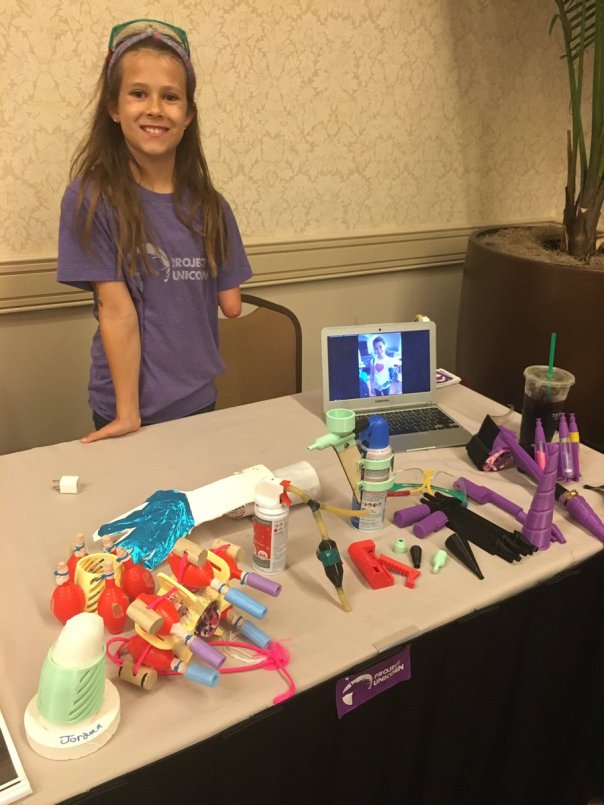
#bornjustright: making her own prosthesis with Project Unicorn
Making your own prosthetic hand? Sounds impossible, but kids are doing it with 3-D printers. I read about this on the program at the Maker Fair this week in DC, sponsored by the MedS
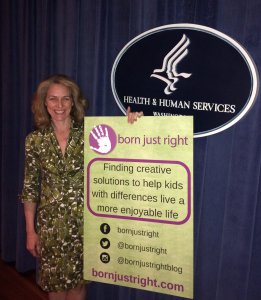
Susannah Fox, CTO of HHS, at the Maker Faire 6/23/16
 and the enthusiastic crowd of 400 that filled the Hyatt ballroom to capacity. Fashion students from Philadelphia, attending on free tickets but buying Hilfiger’s book, were thrilled to be there, along with many many on the Chamber email list, some U.S. 1 readers, and people who heard about it on the radio (I polled those standing in the booksigning line that curled around the room.)


 Rich Rein (Princeton, Class of ’69) will speak at the Princeton
 Princeton Comment